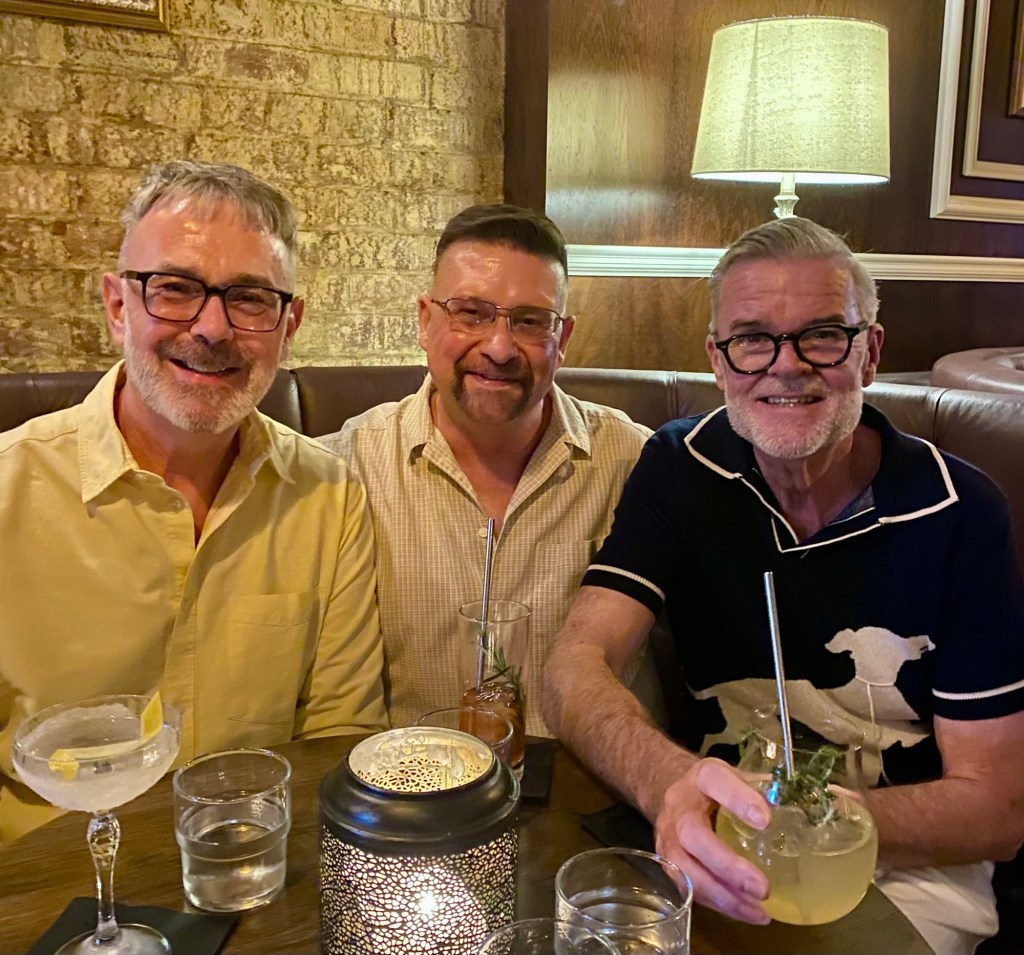
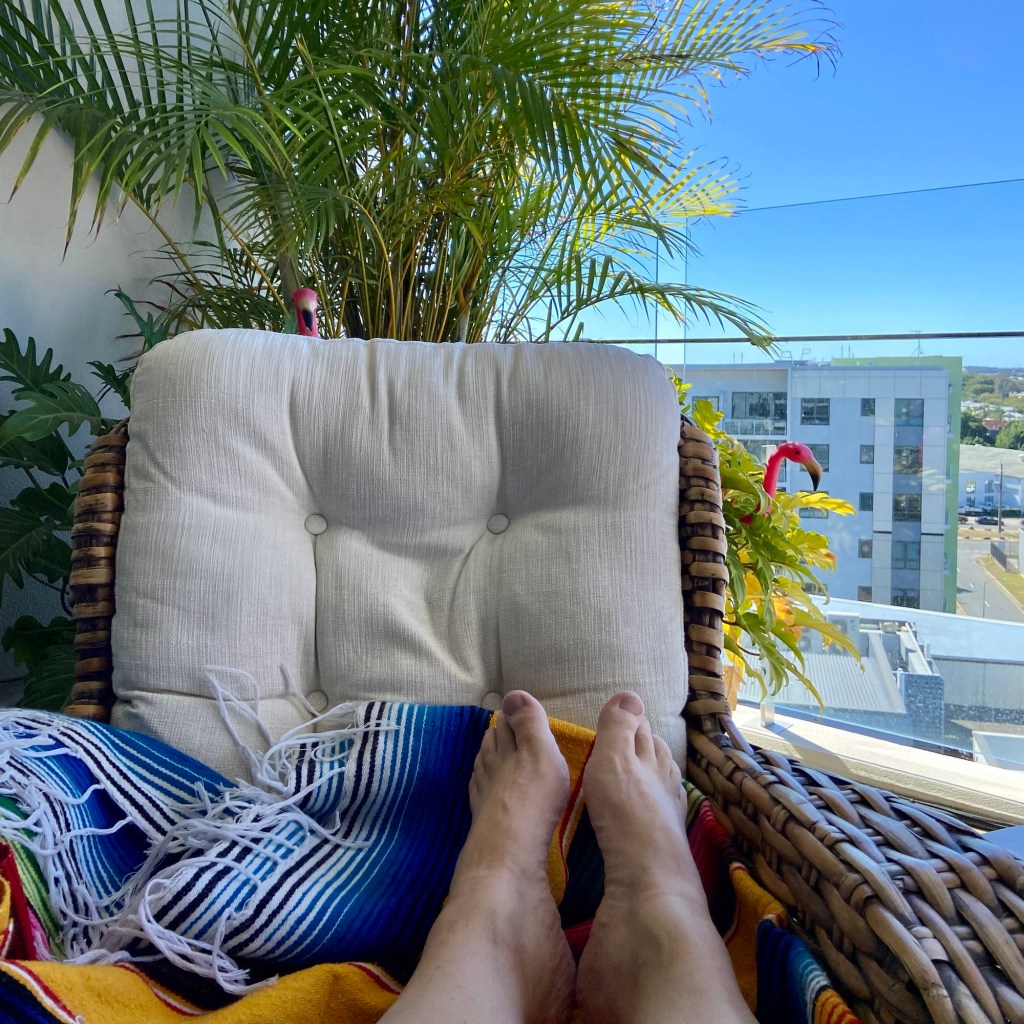
Next time, I am twenty one again will be when I turn eighty four. On Saturday, we began the celebration at home with espresso martinis on the balcony with salted nuts and assorted Lindor chocolates.
Dodging the showers, we arrived on time for more cocktails and a six course Hooked banquet lunch at Fosh, Portside: brioche and whipped taramasalata, natural oyster, crudo scallop, Thai fish curry and roti, twice cooked chicken with mixed leaves and skin on French fries, and finished off with fruit pavlova and sauce anglaise.
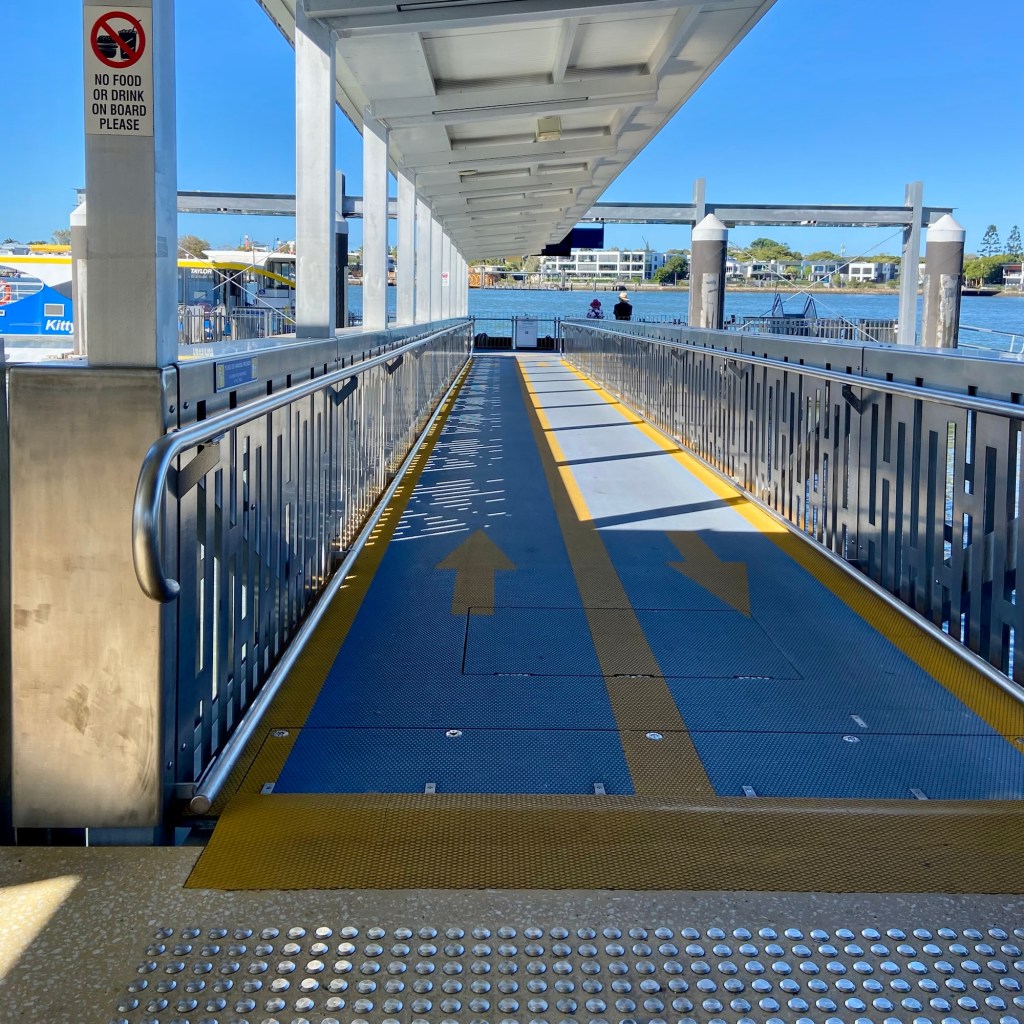
Leaving around 3:00pm, we headed to Brett’s Wharf to catch the Brisbane Rivercat to Riverside, and a short promenade to Dr Gimlet, Edward Street for the gin trolley. Unfortunately, one of the wheels had fallen off. This did not douse the high spirits of three men over sixty and two in their mid-fifties.
Three or four drinks later, the sexagenarians were feeling peckish so headed to Fish Lane, South Bank by Uber. The intended venue had a one-hour wait for a table so the trio went to Hello Please for prawn toast followed by chicken Katsu.
At around 8:30, triple trouble enjoyed an asparagus and broad bean entree and tatufo pizza with valpolicella, this wrapped up the evening.
Sunday was a decidedly recovering dead duck.
Today, we picked up Stan and have enjoyed Campari spritz, prawn cocktail, and are looking forward to slow-cooked chicken breast in tomatoes, red wine, balsamic vinegar, oregano, thyme, and smoked paprika with roast potatoes and carrots, broccoli and peas.
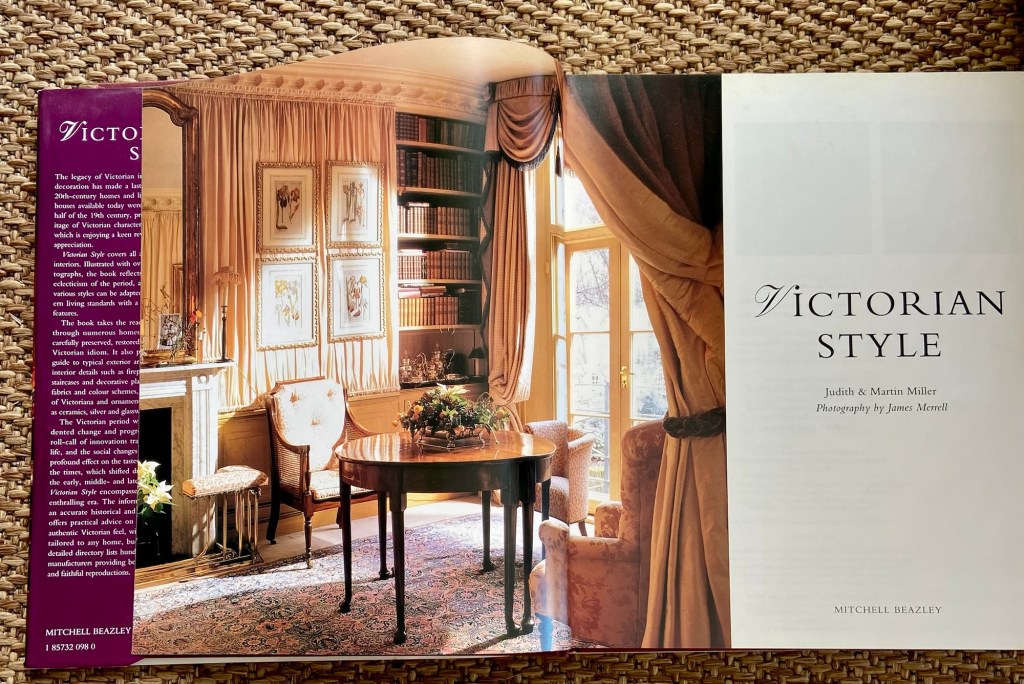
A gift from my husband in 1995, includes a directory of businesses.
Period dreams Of parlour scenes, Of unseen teams of seams, Of ruffles, tucks, and pleats, And buffed beeswax scent. Ceiling traces chandelier shadows Of sweeping curlicue swirls.
‘Neath Corinthian cornice, Spiralling spires sneak Up Lincrusta frieze, Silent sentinel to Crackle-popping hearth’s Radiance, dancing Upon glazed sage tiles, landscapes, and portraits, hung high and low. Either side, old-gold-braid-framed moss velvet wingbacks slouch; ‘Twixt them purple paisley poufs pout.
Candelabra twirling fronds furl, Atop antique raspberry damask swathed mantel. Eternally Diana hunts above dado, Reflected in gilt encased overmantel.
Behind the bullion-fringed ivory brocade chaise, Fenestra layered by blinds and voile, Interlined Sanderson rose chintz drapes snuggle beneath Shrugging swags into tails. Against north’s icy past.
Dark oak polished parquet Washed by apricitic ruby, emerald, amber lights Borders muted-toned chinoiserie rug.
Panelled portal: a glimpse of Hands-‘n’-knees scrubbed, Geometric Victorian-tiled moiré-striped hall, Echoes heaven’s strain of “Twist again like we did last Summer”.
Week one of resuming pre-operation hours at work. Week two of commuting into the office two days per week.
Yesterday and this morning, I missed the first bus into town and the usual battle to alight on Adelaide Street. The second bus was thankfully sparsely populated at both the beginning and end of the journeys.
Arriving at my pre-booked desk around 7:20 am, I check in, wander around to locate the chair tagged with my name, unpack the laptop, exercise flexi-tube, mousepad, headset, phone charger cable, and food from my backpack, then retrieve the ergonomic keyboard, water flask, left-hand mouse, fan, cups, and Twinings Lady Grey teabags from my locker. This takes another ten minutes.
Hot-desking frees up resources, and leads to additional time being spent setting up and clearing away each day.
After logging into the laptop, opening the internet and launching cloud-based telephony, timesheet, chat, mail, calendar, notes, calculator, case list, work items, and AI; using TheraPutty and elastic bands to complete my hand exercises; catching up with teammates, both in person and online; and making a cup of tea, it is 8 o’clock — time for breakfast.
I’m much more productive on the three days I work from home.
Yesterday, following an hour participating in team cultural development, completing a proactive case review with my line manager and an external psychologist, and updating case notes, it was time to head off to my own psychology session.
Navigating my wheelie walker — I haven’t named it yet — across the varied textured pathways, ramps, roads, drains, potholes, service and manhole covers, and tactile indicators of Brisbane, my right hand was numb from the vibration. The right carpal release surgery is scheduled for 20 October.
I arrived late for my appointment, in pain from the hip, hot, sweaty and feeling stressed. We discussed this in the session in relation to goals versus values, and boom-and-bust cycles. I could relate to both concepts.
When able, I push myself, driven by a goal, without stopping to think about the impact on my values.
And I have a new one: independence.
I had this one wrapped up in authenticity. I find it amusing how values may pop up unexpectedly when they are challenged.
Community is another new one.
The trip home went like a dream: catching the 60 from Adelaide Street to Teneriffe Wharf, the ferry to Brett’s Wharf to be met by my husband and Stan, followed by a slow, controlled, supported hobble home.
The most delicious chicken Tom Yum soup served in an elevated bowl surrounding a spirit burner.
Lunch with work colleagues on Thursday at Phat Elephant, Brisbane. Located on the first floor overlooking Adelaide Street and Anzac Square. It can be accessed via Post Office Square to avoid the stairs.
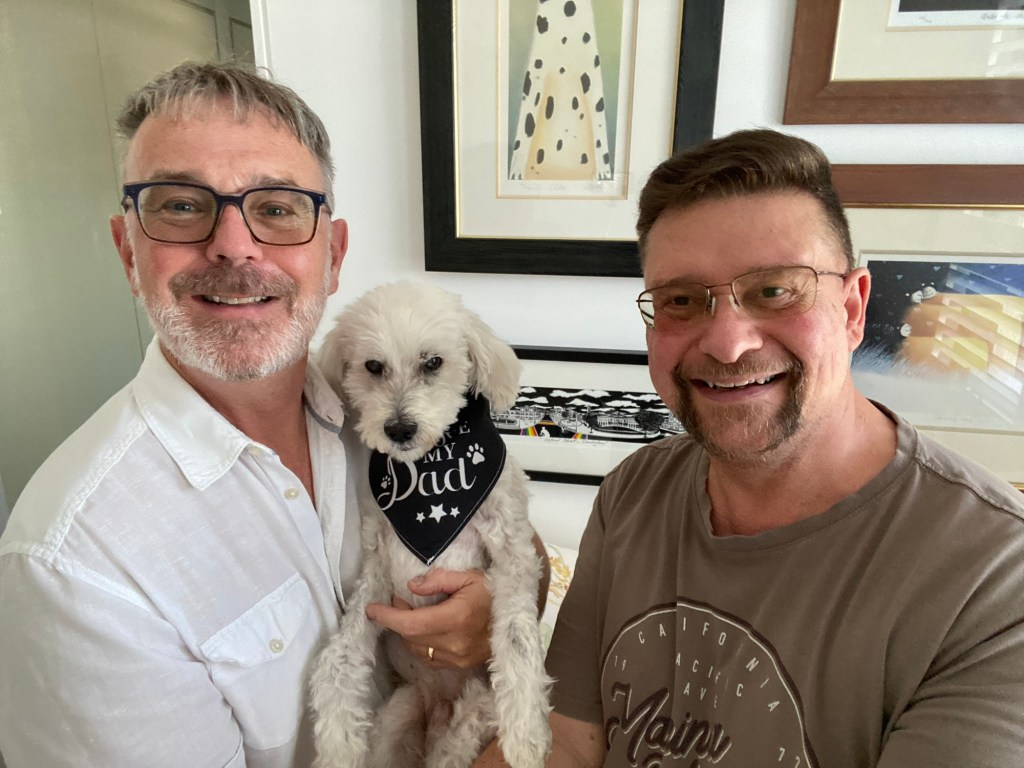
On Friday, Carenza of Balmoral Urban Country Club, formerly School of Etiquette drove to us to deliver the “I love my Dad” bandanna before travelling overseas for their holiday, yesterday.
In his 17th year, Stan has significantly slowed down, sleeping deeply for most of the day. We caught him mid-doze for this picture. He would not usually pose.
On my graduated return to work, this week, I completed six hours on Monday, Wednesday, and Friday.
For two hours on Wednesday, I participated in an in-person two-hours’ workshop on improving conversations. Slido is used for participant feedback, I’m guessing to make it more accessible for everyone. I forgot and launched into a diatribe of an example of how I had fulfilled my employers goals, values, and demonstrated OARS (acronym starting O for open questions, A for affirmation, R reflecting, and S for summarising).
One of the two presenters thanked me for sharing and reminded me we were typing our responses. Whoops!
The next one, whoops that is, came when all those that were able to (I’m using a wheelie walker for mobility) needed to stand for Simon says put your hands on your head, Simon says put your hands on your shoulders, Simon says put your hands in your nose.
What an enjoyable moment until the presenter said “clap”. Guess who was the only one. Silence, faux-pas number two. Did this influence my ongoing participation? I was oblivious to the rules of Simon says. It must be five decades since I played it.
It’s been one of those weeks where everything hits at once. Great news: I don’t have dementia. I do have severe depression, and when physical pain and systemic frustration pile up like they have over the last few days, it takes everything not to let the weight crush you.
Last Thursday was a logistical nightmare that turned into a physical disaster. With our car in the garage, I had to rely on public transport to get to my hand therapy appointment at Brisbane Private Hospital. What should have been a simple commute became a grueling obstacle course—navigating a total of 109 stairs across the journey, including all 86 steps of Jacob’s Ladder.
Between a broken wheelchair lift, steep incline, and hauling myself up those steps one painful push at a time, my body took a beating. Stupidly, using my left hand at the first flight from Adelaide to Ann street to grip a handrail triggered sharp, shooting pains in my wrist right after making good progress in therapy. Worse, the exertion flared up excruciating pain below my right knee and a stabbing ache in my right hip, leaving my mobility severely compromised.
By the time I tried to head home, a packed bus meant no priority seating, forcing me to give up, hobble down Adelaide Street, and wait in Hutton Lane for my husband to collect me.
Adding insult to injury is the ongoing battle with the insurer. They previously denied my right hip claim, citing “no material change.” Yet the objective imaging tells a completely different story: moving from joint space reduction in late 2022 to severe, bone-on-bone contact, sclerosis, and large osteophytes by early 2026. Carrying a 6–7 kg laptop bag on a commute isn’t just an inconvenience—mechanically, it adds dynamic force to a joint that is already structurally failing.
To top off the noise, I’ve ditched Facebook and Instagram for the third time. Bluesky is a bit less satisfying, but stepping away from the main algorithmic circus feels necessary right now.
I’m resting, recovering, and preparing for my next steps. One foot in front of the other—even when every single step is a fight.
Yesterday, I was nursing a bit of guilt. As part of my graded return to work, I only managed two four-hour shifts last week thanks to the hip injection. This week, it’s just one four-hour shift, sandwiched between Wednesday’s Ekka public holiday and a Friday psychology appointment to assess for early onset dementia.
Even though I’ve labelled myself Gen X for decades, I was surprised to realize my work ethos is far more Boomer. Turns out I sit right on the cusp—that late-Boomer, early-Gen-X overlap often dubbed “Generation Jones” (bizarre, given my surname). It blends Gen X’s cultural cynicism with that Boomer-driven pride in showing up, doing things thoroughly, and pushing through. That goes a long way toward explaining both the lingering work guilt and the path that led to my injuries in the first place.
On Monday afternoon, my husband suggested we do something the next day. My brain immediately ran its usual diagnostic: How far do I need to walk? How much will it cost? Can we take Stan?
We considered catching a ferry, but decided to test out the hip locally instead with a flat, 30-minute stroll to Riva Kitchen and Events at Northshore Hamilton.
It was an east-west breezy kind of day. I pushed Stan’s stroller to help with my balance, while he trotted in front in a futile attempt to wear him out before we arrived. In his dotage, dining out with Stan now involves managing a relentless demand for treats—there are never enough in the whole wide world to satisfy him. Today was no exception.
Sitting there enjoying a chicken schnitzel on a bed of arrabiata, topped with wilted greens and paired with an organic Italian Pinot Grigio, I caught sight of a brick chimney stack across the river. I mentioned to my husband that it reminded me of the old kiln chimneys in Sydney Park.
From there, my mind took a complete flight of fancy, drifting back to childhood Sunday outings from Birmingham—Hartlebury Castle with its bishop’s palace and gypsy caravans, the grand Queen Anne elegance of Hanbury Hall, the secret priest holes at Harvington Hall, and the rustic converted barn workshops of the Jinney Ring Craft Centre.
Funny how much life changes, even when you navigate it with a largely laissez-faire mentality.
Yesterday, I was nursing a bit of guilt. As part of my graded return to work, I only managed two four-hour shifts last week thanks to the hip injection. This week, it’s just one four-hour shift, sandwiched between Wednesday’s Ekka public holiday and a Friday psychology appointment to assess for early onset dementia.
Even though I’ve labelled myself Gen X for decades, I was surprised to realize my work ethos is far more Boomer. Turns out I sit right on the cusp—that late-Boomer, early-Gen-X overlap often dubbed “Generation Jones” (bizarre, given my surname). It blends Gen X’s cultural cynicism with that Boomer-driven pride in showing up, doing things thoroughly, and pushing through. That goes a long way toward explaining both the lingering work guilt and the path that led to my injuries in the first place.
On Monday afternoon, my husband suggested we do something the next day. My brain immediately ran its usual diagnostic: How far do I need to walk? How much will it cost? Can we take Stan?
We considered catching a ferry, but decided to test out the hip locally instead with a flat, 30-minute stroll to Riva Kitchen and Events at Northshore Hamilton.
It was an east-west breezy kind of day. I pushed Stan’s stroller to help with my balance, while he trotted in front in a futile attempt to wear him out before we arrived. In his dotage, dining out with Stan now involves managing a relentless demand for treats—there are never enough in the whole wide world to satisfy him. Today was no exception.
Sitting there enjoying a chicken schnitzel on a bed of arrabiata, topped with wilted greens and paired with an organic Italian Pinot Grigio, I caught sight of a brick chimney stack across the river. I mentioned to my husband that it reminded me of the old kiln chimneys in Sydney Park.
From there, my mind took a complete flight of fancy, drifting back to childhood Sunday outings from Birmingham—Hartlebury Castle with its bishop’s palace and gypsy caravans, the grand Queen Anne elegance of Hanbury Hall, the secret priest holes at Harvington Hall, and the rustic converted barn workshops of the Jinney Ring Craft Centre.
Funny how much life changes, even when you navigate it with a largely laissez-faire mentality.
I took a Valium prior to having my first ultrasound-guided steroid injection into my left wrist. The intent was simple: to calm my nerves, as I feared the thought of the procedure.
There was no need for the pre-med before my right wrist injection. Being externally funded, it required only a short, easy drive from home.
Yesterday, however, my husband took me for an ultrasound-guided steroid injection into my right hip. This time, the radiology practice bulk-billed. I didn’t have to pay a $210 gap payment after my Medicare entitlement was applied, though it did mean a 40-minute drive each way to avoid the tolls. I hoped it would provide temporary pain relief and improve the mobility stolen by osteoarthritis.
Until recently, my need for medical procedures had been scant.
My blind trust in the UK’s National Health Service was forged during childhood, built on the back of my mother’s frequent inpatient hospital stays and our regular visits to the family doctor. Whenever Mom, me, and my two younger brothers had health issues, she would march us from our home in Capern Grove, left into Welsh House Farm Road, left again at Tennal Road, and right into Tennal Lane. Our destination was number two: the surgery of Dr Ezzat, who practised out of a converted interwar house built somewhere between 1920 and 1935.
Access was gained through a large timber gate, along a short path bordered by shrubs and trees, and up a couple of steps to an imposing Georgian/Art Deco portalled front door. Immediately inside, patients stood on immaculately polished, dark brown linoleum that ran throughout the building. We reported to a receptionist, summoning her attention by pressing a doorbell mounted on a cream-painted timber and obscure-glazed partition wall. A small sliding hatch would snap open; you announced your name and were told to go to the waiting room on the right.
The high-ceilinged, cream gloss-painted room had two heavily curtained windows to the right and another at the far end. There was a boarded-up fireplace to the left, and a centre table piled with ancient magazines, including Reader’s Digest.
Upon entering, you took your place on the first of many mismatching, dark Thonet bentwood dining chairs lining the room. If there were no chairs available, you stood. They creaked as you sat down and shifted your weight on the small, round, hard relief-patterned seats.
A buzzer proclaimed when the doctor was available for the next patient. The person sitting next to the inner door—on the same wall you had entered through—would get up, open the door, and vanish. Everyone else then moved along one seat, like a sombre game of musical chairs.
It could take a few hours waiting your turn in that gloomy, overheated room filled with crying babies and coughing, sneezing people. Finally, your chance arrived to proceed along a passage behind the records-reception room. You would knock on the doctor’s door, await a muffled ‘Enter’, and step into a bright, white gloss-painted room with a window overlooking the west-facing garden.
The doctor sat at a large, heavy, dark timber desk on the left, beneath a wall-mounted cupboard. You were invited to sit to their left. Dr Ezzat would turn to face you in a dark, padded leather swivel chair that had seen better days. ‘Mother, what can we do for you today?’ he would ask. This ageing, gentle, kind, and direct Egyptian man listened intently. He inspected chests with a cold stethoscope and checked tongues and throats with a routine ‘Say argh’—seemingly his remedy for all ailments.
Exiting past chrome-framed, glazed cabinets housing disturbing-looking medical instruments brought you right back to the entrance. When I grew older, I went to the doctor alone. I trusted him completely and felt safe in his care.
In my teens, however, that safety wavered. I was sent to Selly Oak Hospital in Birmingham for a blood test, likely to check for an iron deficiency. In those days, blood was painfully drawn with a thick syringe. Afterward, I couldn’t wait to escape into the fresh air. I rode the bus home experiencing violent, cold shivering. A profound, lifelong fear of needles was born.
Forever the fool, I assumed this hip steroid procedure would somehow be a similar experience to my wrists. I had researched what to expect and was somewhat surprised when I wasn’t asked to change into a gown. Instead, I was escorted by Damian, who was clad in mid-blue scrubs, straight into a large CT scan room. He briefly explained the procedure: local anaesthetic, followed by a CT-guided injection. I wondered what had happened to the ultrasound-guided version I expected.
I was asked to empty my pockets, leave my bag on a chair, and lie on a bed facing a doughnut-shaped machine. A similarly clothed second person introduced himself as the doctor’s assistant, and then introduced me to the doctor. They all wore the same uniform! The assistant reiterated the process, placed a pillow under my knees, and asked me to pull my loose-fitting shorts to my knees and slide the waistband of my underwear down. This exposed the intended site of the injection: my groin. Bizarrely, I had imagined the needle would go into the outside of my hip.
I was sent in and out of the scanner a few times while a screen above me flashed light shapes against a dark background. Next, a pale blue sterile drape was placed over the site. The doctor explained there would be a sting from the anaesthetic, followed by pressure from the steroid injection that might travel down below my knee.
Following an extremely sharp sting of the local anaesthetic, an unpleasant sensation bloomed in my groin, and I attempted to summon my bravery. Closing my eyes, I wondered if it was too late to back out—if I should just live with the ongoing pain and reduced range of motion. The machine was cranked up to full speed and volume. A strange, food-like odour permeated my nostrils, and I briefly wondered if I was cooking. Suddenly, my leg jolted as the steroid went in, sending my entire body into full tension. The doctor told me I was doing really well. I certainly didn’t feel like it, but he promised it would soon be over.
He noted that the pain relief might last for six to nine months, at which point I could have it repeated.
Once the assistant and Damian helped me sit up, my head went woozy. I told them I felt dizzy and started sweating. That teenage bus ride in Birmingham flashed vividly back into my mind. I was laid back down and asked to move onto a trolley—an unwise manoeuvre in hindsight, considering I was still recovering from carpal tunnel release surgery on my hand just three weeks prior.
I kept my eyes closed while being wheeled down a thankfully refrigerated corridor, praying they would not leave me exposed in the main waiting room. I was rewarded with a tiny, screened-off alcove in a side hallway where there was no rush for me to leave. Retrieving my phone from my bag, which had been dumped on my chest, I called my husband with an update. He was parked nearby and promised to pick me up whenever I was ready.
I gave myself five minutes, sat up, slid on my Birkenstocks, and navigated my way back to the reception area. Clinging to the counter, I waited for a form to sign, called my husband to say I was at the front, and waited to be collected and taken home.
Next time, I will definitely take a Valium beforehand.
For an idealist, reality is the foulest tasting pill to swallow, let alone digest. Gaily floating around on a cloud of optimism and wonder one second, to thudding to earth, gasping in lungs of detritus, the next.
From experience, a sound night’s sleep goes someway to reset and resume the ascension of the ladder of acceptance and commitment, through adaptation and evolution.
My delusions of grandeur know no bounds!
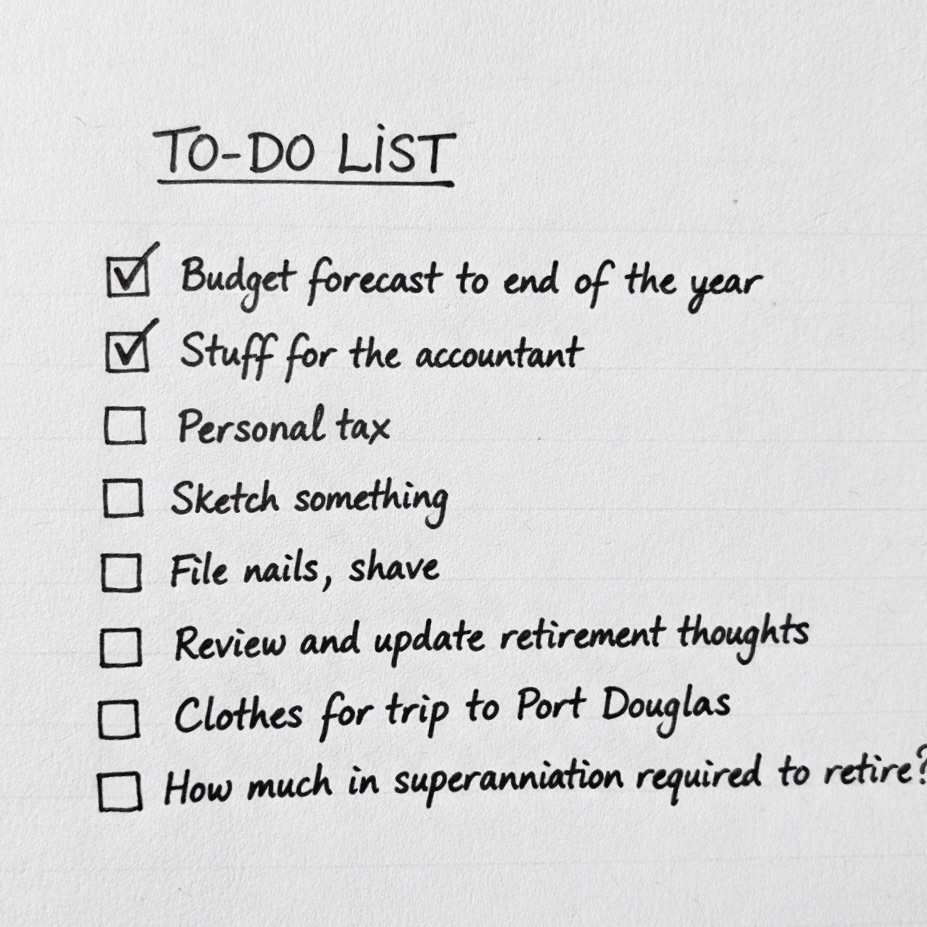
It is the King’s (previously Queen’s) birthday, long weekend in Queensland. A perfect opportunity to reflect on personal and financial duties whilst enjoying a break.
Balancing optimism with responsibility is a dance requiring grace and acknowledgement of reality. How do you strike that balance in your own life?