Desperation

Horse and Groom public-house, right of the mansard roofed building

I find it strange, as a youngster, we only seemed to spend time with my grandparents, and Mom’s brother and his children. I assumed we were from a small family. From researching the family tree, I have found many relatives lived locally in Birmingham, UK and farther afield.

When Mom met Dad in Bridgnorth, Shropshire she was working in the office of Tangyes Ltd., a company making hydraulic and general engines. Dad learned his trade as a tool-maker through an apprenticeship. He went on to learn gas fitting and central heating installation. I guess travelling around may have been how he met his second partner.

Mom told me she got together with my stepdad because he was nice and she was in financial dire straits. I believe he did his best, having a wife packaged with two step sons.

I remember one payday, after my stepfather had gambled most of his cash pay packet away on the horses at the smoke filled bookies, also known as the betting shop and turf accountant, he drank the remainder at the Monarch pub before returning home.

My mother’s protestations were met by his fists causing her to fall down a flight of stairs. A catalyst for Reverend Kerr of Saint Boniface Church to arrange for our escape to a battered wives home in Sparkbrook.

I came across the following newspaper report while researching Mom’s maternal family. It is transcribed from the Birmingham Gazette, Birmingham, West Midlands, England. Monday 06 October 1913

SMASHED WINDOWS.
WOMAN’S PROTEST AGAINST A PUBLICAN’S ACTION.

At the Birmingham Police Court on Saturday a married woman named Mary Ann Edmonds, aged 34, living at 65., Birchall Street, was charged with wilfully breaking two plate-glass windows, of the value £3 10s., at the Horse and Groom public-house, Digbeth.
William ‘Henry Phipps, the licence-holder, said that at six o’clock on Friday night, just after he went into the bar, defendant’s husband came in and called for half a pint of beer. ” He was practically ‘ sober, ” said witness, ” so I served him with half a pint of beer. “
Immediately he was served, witness continued, defendant caused an obstruction outside, causing a crowd to assemble. Witness went out with the intention of getting her away, and immediately after she threw two half-bricks, one at each window.
Defendant in the dock admitted that she did the damage, but said she was driven to desperation. Her husband spent all his wages at this house. They served him until be could not stand, and then had practically to carry him from the house.
On Friday night, as soon as her husband enteral the house, she asked the landlord not to serve him, and said, ” You see the condition he is in.”
Phipps, defendant said, ordered her out of the house as they did not want her there.
Defendant added that she knew she did wrong, but she had four little children starving at home, and in her madness she did not know what she did.
Mr. Hobbis (chairman), recalling Phipps, asked him what he meant by saying defendant’s husband was ” practically ” sober.
Witness: He might have had a little, but he was not drunk.
The Chairman: When yon speak of a man as sober we understand he is sober, but when you say practically sober it is a different thing, and we want to know what you mean exactly. Was he under the influence of drink?
Phipps: None whatever. He walked straight into the house, as if he had come straight from work.
The Bench came to the conclusion that the defendant had cause for great exasperation.
They believed her story, but that did not excuse her for breaking windows. They had come to the conclusion that the case would be met be imprisoning her for one day, which meant that she would be at once discharged.

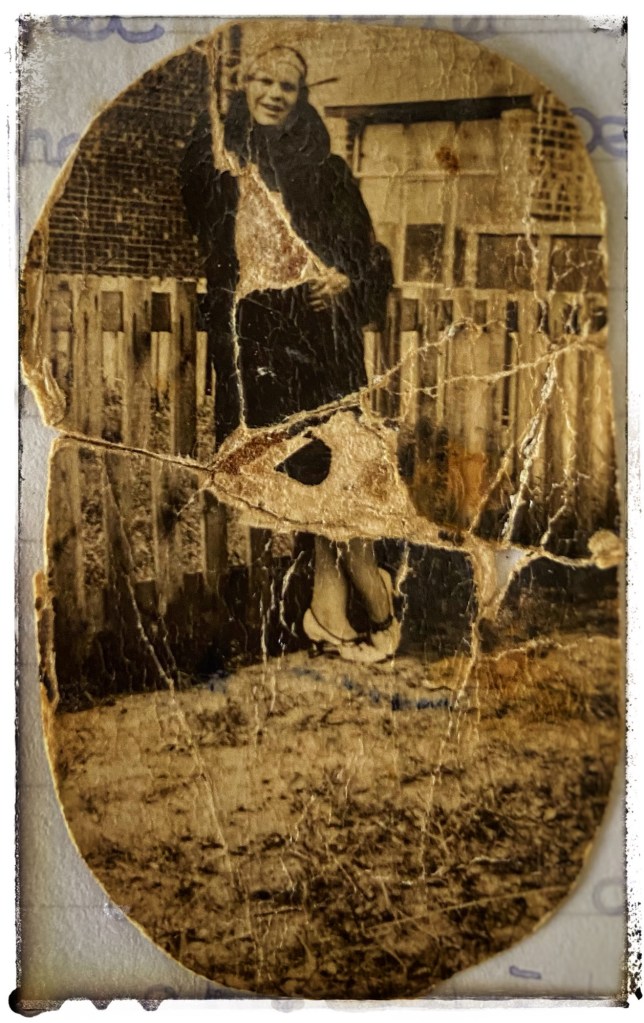
Monarch pub prior to recent refurbishment

Big Nanny, Hilda May

Today, 2 July 2024, ‘Big Nanny’, my maternal grandmother would have been 118 years old. This is the only photograph I have of Hilda May Edmonds, born at the dawn of the 20th century.

According to the 1911 Census of England and Wales, Hilda aged 4 lived at 123 Winson Street in the working class suburb of Winson Green with parents Robert, 39 and Mary, 41, brothers, Willey, 10 and Joseph, 8, and two boarders, James Aspinall, 71 and Margery Grattage, 3.

Hilda’s, Mom, Mary had given birth to five children, two were deceased. Ivy passed when 2 years old in 1901. I have not yet identified the other child.

Approximate location of the house

Robert was employed as an art metal worker making fire screens. According to the 1891 census, art metal work had been his occupation since the age of 19. Robert had a background in metal, hailing from a family of brass founders and casters.

Typical Victorian house plan

The Victorian terraced house no longer stands. It may have been a two up, two down plus attic bedroom facing the street with a rear courtyard containing a communal outside washhouse (laundry), and toilet connected to the sewer, a luxury, at that time for the less well off.

The house was located a hop skip and a jump south west of Winson Green Prison (the last execution was carried out in 1972), City Lunatic Asylum (became All Saints mental health Hospital), City Fever Hospital, and the Birmingham Union Workhouse. The Workhouse site later became Dudley Road Hospital.

Winson Green at the turn of the century

I was unaware of my family’s connection to Winson Green when I was getting industry experience working for six months’ in one of the Dudley Road Hospital kitchens in 1984/85.

Hilda left home to marry Dennis Havelock Jones in 1928.

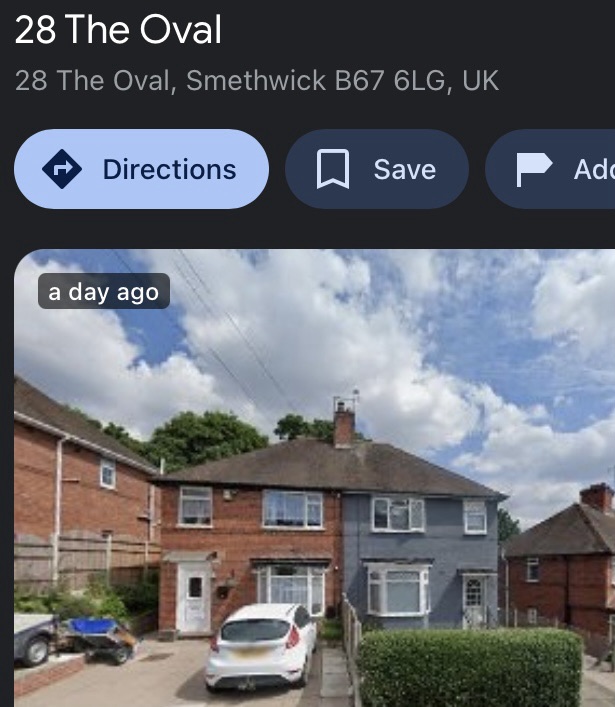
They lived in a 1920s house, 28 The Oval, Smethwick (promounced Smerrick), Staffordshire with children, Norman, Irene (my Mom), Denise, and Frank.

The grey house is no. 28, Google street view

The eldest, Norman passed away due to gastroenteritis when 6 years old in 1934.

My Mom, Irene was born in 1935. This picture was taken on Mom’s first birthday. Mom contracted polio when she was 14 months old.

Mom recounted, before the start of the Second World War, Uncle Ben visited from America. He offered to take the children home with him, away from the anticipated bombing. The family decided to take their chances, the children stayed at home in England. Granddad built an Anderson Shelter in the back garden.

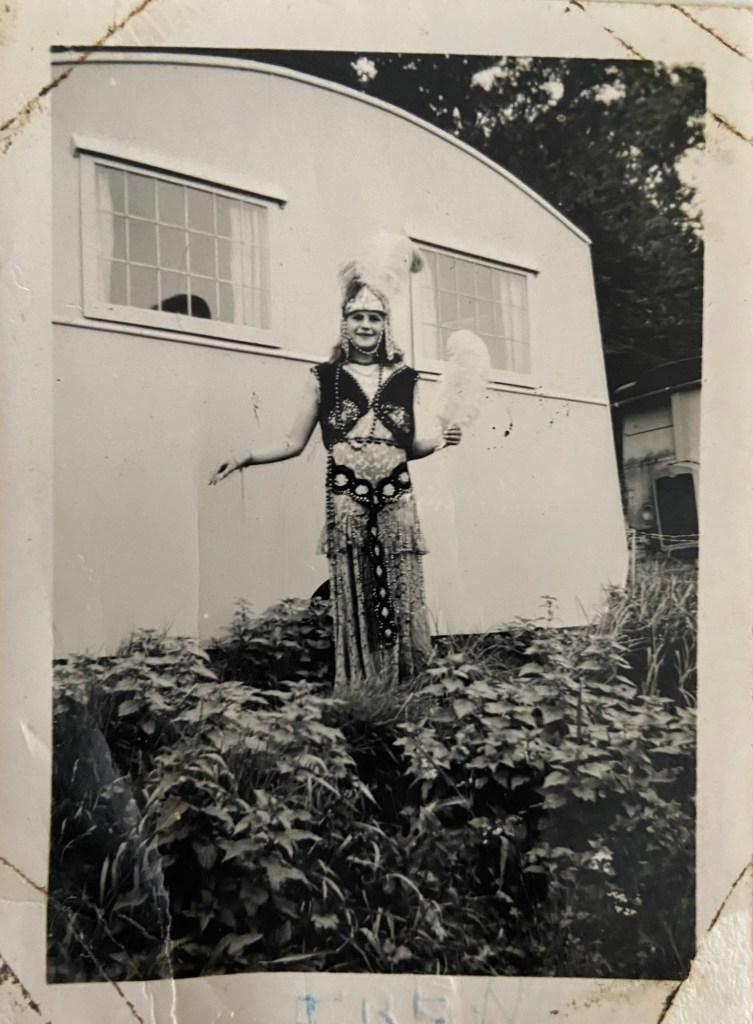
12 year old Mom in fancy dress outside the caravan

After the war, the family enjoyed holidays in a caravan built by Granddad. It was located in Bridgnorth, Shropshire on the bank of the River Severn. My Mom met my father, Trevor there, he had been camping nearby.

Denise’s husband of 4 years went off with another woman in 1962. It was too much for Denise, aged 23 to bear, she gassed herself by putting her head in the oven. My Mom and Uncle Frank found her slumped against the stove.

My Mom told me Nan was devastated by Denise’s death. She refused to leave her bed. My Mom and Dad agreed a grandchild was what Nan needed to lift her spirits.

This is where I entered the story in 1963.

I have only fond memories of my rotund, jolly, loving, type 1 diabetic, Big Nanny living with Granddad and their dog, Sue. I wonder, if Nan ever removed that hairnet and button up tunic she wore over her clothes. Maybe to go out in the blue Morris Minor van with Granddad.

I remember the semi detached house with a tiny entrance hall, a staircase ahead, and the front (best) room off to the left. It was used to receive visitors. My brother and I were not allowed to be in there without adult supervision.

The walls of the room were papered with a toile de jouy pattern.

A white Sylvac hyacinth mantle vase with wire flower holder insert stood on the bay window cill along with cast brass ladies wearing crinoline dresses.

A high back three piece suite, upholstered in dark grey with small burgundy crosses and topped with antimacassars faced a tiled fireplace with a gas fire. There was also a coffee table, hearth rug, and a potted aspidestra atop a tall timber plant stand.

I assume Granddad had modernised the panelled doors by adding hardboard and painting them white. Drive-in ball catches had also been installed. A shelved under stairs storage cupboard was accessed from next to an upright piano. The space had a small stained glass window looking into the lean-to garage at the side of the house.

Next to its door, another led to the kitchen. It was furnished with a large table, a small two seat sofa with wooden arms and green seat and back cushions in front of a fire, a dark red rag rug, a green enamelled gas stove with eye level grill, stainless steel sink with draining board and yellow Formica sliding door cupboards.

Nan would let me light the kitchen’s gas fire using a wooden spill from the pot on the tiled mantle. I was encouraged to help peel vegetables, shell peas and chop mint grown on Grandad’s allotment.

Granddad liked his sausages skinless so Nan would give the skins to me to take to Sue outside. I didn’t tell her, sometimes Sue shared her raw sausage casings with me.

As a treat, Nan would give me ‘a piece in the dip’. She used a long serrated knife with tiny teeth to slice the crust off a white tin loaf then dip its face into the juices of the Sunday roast. I would add ground white pepper and savour each mouthful of this prized gastronomic delight.

There was a huge glazed lean-to at the back of the house accommodating a workshop, toilet, and the laundry gadgets from across the decades including, a copper, washtub, dolly, and mangle. By the ‘60s Nan was using a gas powered washing boiler and an electric cylindrical spin drier. Monday was wash day in the Jones household.

Outside there was an old crock sink mounted on a stand both painted green and filled with red geraniums. A long lawn lined with orange marigolds stretched towards Grandad’s green painted shed and beyond a gate into Mrs Millington’s garden. A washing line stretched as far as the eye could see.

Up the narrow, steep staircase there were three bedrooms and a bathroom. The bathroom had dark brown linoleum floor covering, cream painted walls and gleaming white fittings with chrome taps. The taps, tee shaped from the side were connected through the back of the square porcelain sink and the end of the footed iron bath. The vertically mounted, cross headed taps had small white porcelain discs, indicating ‘hot’ and ‘cold’. There was resistence when turned, emitting grinding screeches followed by soft pops.

The water gushed from the bottoms of the taps with what seemed like the force of fire hoses, even though it took forever to be deep enough before I could climb into the gargantuan steaming vessel. Once inside, the bottom and sides would feel icy against my skin. Also, the enamel was a little rough from eons of scouring with Vim powder.

My last memory of my Big Nanny is from 1969. She was in bed in the best room. It had been brought downstairs as she was ill and there was no toilet inside the house. I took the gift of a dolly I had made from strands of pale blue wool.

Sadly, cancer of the liver got the better of Big Nanny, passing away on 5 January 1970, aged 63 when I was 6. The wool dolly accompanied her to her final resting place in Uplands Cemetary, Smethwick.

Ernest Bristol Binding

HMS Bulldog*

I have been researching our family trees. There have been interesting discoveries.

During the First World War, my husband’s grandfather, 26 years old, Able Seaman, Ernest Bristol Binding was serving onboard Beagle class destroyer, HMS Bulldog (1909).

‘On 16 April 1916, while on G Patrol off the mouth of the Dardanelles, the Bulldog struck a contact mine off Gallipoli. She was badly damaged aft and suffered the loss of one officer and six men’ (Wikipedia) including, Able Seaman Binding. The body was not recovered.

He was mourned by mother, Mary, siblings, William, John, Mary, Thomas, Maud, Alfred, Godfrey, Elizabeth, and children, Gwendoline, William, and Elizabeth.

Ernest’s service is commentated in Plymouth and Briton Ferry.

*source, http://www.the-weatherings.co.uk/pccship0471.htm

Halcyon daze?

Today, Friday 13th, lunch time, I was drifting off, post quiche Lorraine and salad. My consciousness was teleported to a moment in my teenage years. A warm English Summer’s day in 1979.

I vividly remember the gentle breeze as I lay on a sun parched patch of grass in Birmingham. Dozing as I listened to Knock on Wood by Amii Stewart on a battery operated, handbag sized, portable cassette player with carry handle. Very similar to the one pictured above, I would record songs from the radio.

The weight of my eyelids was getting the better of me as I drifted off whilst reading a paperback science fiction novel, The Weapon Shops of Isher by A. E. van Vogt.

Halcyon daze?

Happy Boxing Day

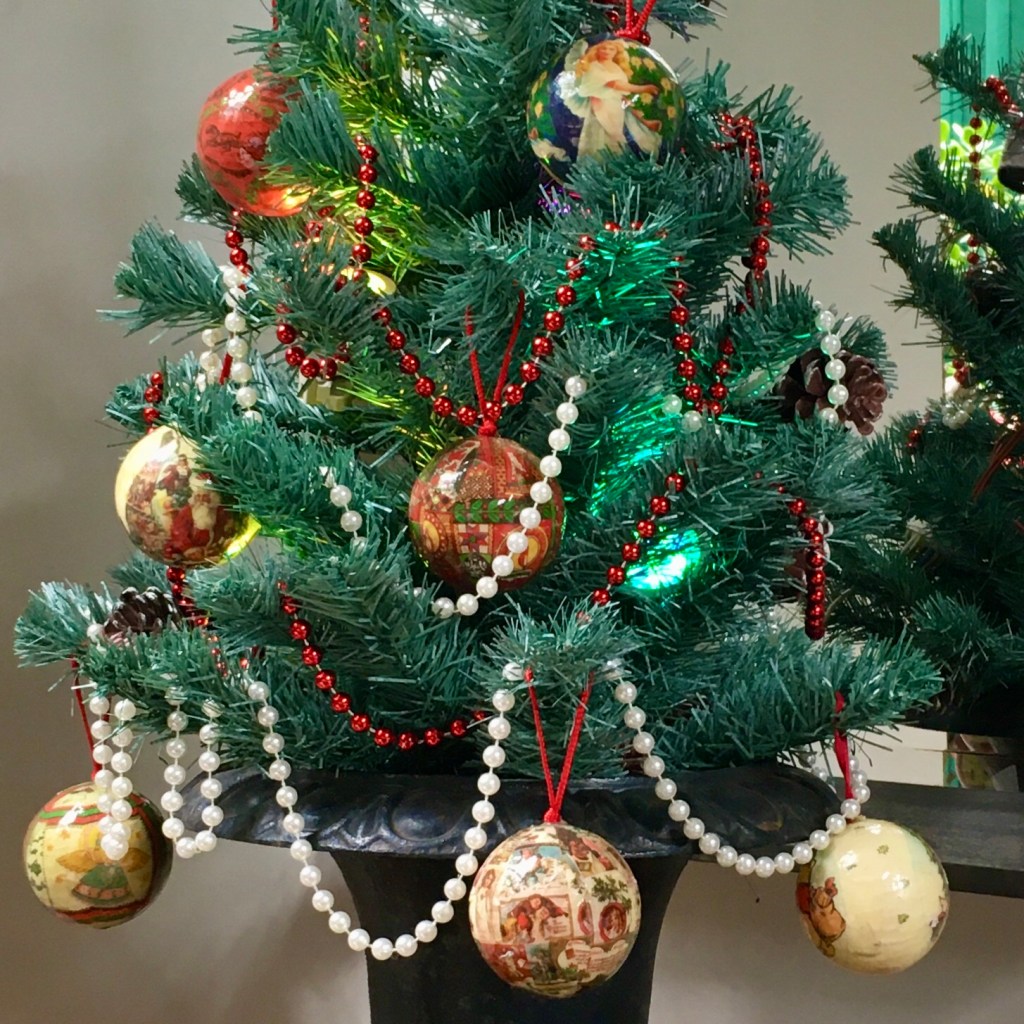
Detail, Victorian inspired papier-mâché baubles

Boxing Day is an English bank (public) holiday.

Currently a favourite for people wanting to grab a bargain in the post Christmas sales and for sporting events including, one day cricket and soccer. The day is not known for boxing.

A round robin of sites courtesy of Google yielded the following theories for the origin of Boxing Day:

Alms boxes
In the Middle Ages (approximately late 5th – late 15th centuries), it was common for churches to open alms boxes on the day after Christmas, distributing all the money inside amongst the poor.

Christmas boxes #1
In Queen Victoria’s reign (1819 to 1891) servants of wealthy household were given a rare day off to visit loved ones. Masters would gift a Christmas box, containing food, gifts and sometimes a financial bonus.

Christmas boxes #2
Tradespeople such as milkmen and butchers would spend the days after Christmas collecting money or gifts left to them by customers. As a child, I remember my mother putting aside some Christmas box money to give to the men who delivered bread, pop (soft drink), milk etc.

After the excesses of Christmas Day, we are spending Boxing Day relaxing with our Sydneysider friends. This evening we will join dear friends for a rooftop barbecue in Newstead, Brisbane.

Blue sequin jacket

In the spa this (Saturday) evening, the 38oC temperature and the Campari spritz loosened my thoughts.

Voicing them, I related my reliving teenage memories of listening to Funny Girl on vinyl borrowed from the Birmingham (UK) Central Library through listening to the soundtrack on Spotify during my journey to work this week.

Funny girl is a stage and movie musical from the late 1960s based on the life of Fanny Brice. Brice is played by Barbra Streisand, one of my teenage idols.

I am platonically attracted to strong females.

In an instant, I remembered, I also love the Neil Diamond, Jazz Singer soundtrack. I have never seen the movie.

My husband said ‘he wears a blue sequin jacket in that’. ‘No’, I replied.

Sure enough you can buy one from The Jacket Shop, Reenactment Clothing for $419.98 USD and it’s in stock!

Aside from the Streisand and Diamond duet of ‘You don’t bring me flowers’ that never happened, apparently delivered to the World by a radio DJ, all mixing.

I prefer to keep my teen years where they belong as memories.

Dame Angela Lansbury

For me Dame Angela Lansbury was Bed Knobs and Broomsticks. 30 years ago I was living in Droitwich, a small spa town in England. The cinema was located in one of the forgotten spa buildings, grandly named the Winter Gardens. Built in the 1930’s, in its heyday it was reputed to have the best sprung dance floor in the Midlands. Rows of seats were screwed to the floor to create the picture palace. The building became a victim of redevelopment at a time of video cassettes and a general loss of interest in cinemas.

I remember with dewey-eyed nostalgia, the musty smelling space with dampness pervading the air. The chill of the place lingered in my bones long after leaving. Those were the days; buying Kia Ora, toffee apples and Cornettos from the usherette and watching cartoons before the feature film. My eyes smarted from the cigarette smoke fuelled haze caught in the oblong light stream from projector to screen. I’m sure I went to the cinema as a teenager more than twice. Yet there are only two movies that I remember seeing: Bedknobs and Broomsticks and Mad Max; significant given my interest in paganism and eventual move to Australia!

Cabot Cove’s television sleuth in Murder She Wrote passed away on 11 October 2022, aged 96.

One of my treating general practitioners remarked to me, the passing of those around us is a reminder of our mortality.

Ekka Day

Yesterday, I was pleasantly surprised to learn Ekka Day was not next Wednesday but today. The news spurred me into finishing things up at work on hump day eve.

What is Ekka Day? I hear you say. It is a public holiday for Brisbane folks to be able to attend the Royal Queensland Show, organised by The Royal National Agricultural and Industrial Association of Queensland.

In true Aussie style the word for show or ‘Exhibition’ was changed to ‘Ekka’. I don’t see this word replacing expo any time soon, keeping it as an Australianism.

Those of you who follow me on Instagram may have seen the above photo taken at Cloudland, Italian restaurant, bar and event venue. Another word anchored in the hearts and memories of Brisbanians or Brisbanites. A taste of a post to come.

David Harvey Lawrence

Other than the 1969 movie of Women in Love starring Glenda Jackson, my knowledge of D.H. Lawrence was virtually non-existent.

To a naive closeted teen, it was shockingly titillating to watch the fire lit nude Oliver Reid and Alan Bates wrestling scene. Especially in a house where sex, intimacy and relationships were never raised let alone discussed.

Inspired by Merchant Ivory’s productions of Maurice and Room with a View, I had spent the 1980s and 1990s devouring and revisiting the writings of E.M.Forster.

Today, 26 June 2022, as I dived into the novel Lady Chatterley’s Lover, 1928, I was pleasantly surprised to find the read enjoyable.

Googling the author, Lawrence, delivers prolific offerings of poems, short stories, travel books, novels, paintings, and non fiction during his short 44 years of life, 1885 to 1930.

Here begins a new obsession.

The photograph is a screenshot from When D H Lawrence’s unlovely paintings were confiscated by Scotland Yard

In the spring of 1801, Ludwig van Beethoven completed the ballet, the Creatures of Prometheus based on Salvatore Viganò’s storyline.

The ballet premiered on 28 March 1801 at the Burgtheater in Vienna with 28 performances. It was premiered in New York at the Park Theatre on 14 June 1808, one of the first full length works by Beethoven to be performed in the United States. It is the only full length ballet by Beethoven.

The Australian premier of Beethoven’s 220 years old music and ballet was a matinee performance on 20 November 2022 at the Twelfth Night Theatre, Brisbane. The ballet was historically reconstructed from the 1801 performance with new choreography by Queenslander, Jayden Grogan.

Lucas D. Lynch, conductor and producer informed the audience he was inspired to share Beethoven’s ballet with Australia after hearing the music for the first time, 14 years earlier.

The plot follows Prometheus stealing fire from Zeus to spark life into two clay figures, thereby creating humankind.

Mostly set on Mount Parnassus, the man and woman encounter a multitude of characters from Greek mythology during their journey from birth through education to their wedding:

  • Apollo (god of music, dance, the Sun, light, and poetry)
  • Amphion (built Thebes with the power of music) playing harp
  • Euterpe (delight) playing flute
  • Orpheus (legendary musician) playing cello
  • Mars (god of war)
  • Melpomene (muse of tragedy)
  • Thalia (one of the three graces)
  • Dionysus (god of the grape-harvest, winemaking, wine, fruit, and theatre)
  • Silenus (drunken god of wine)
  • Pan (god of the wild, rustic music and companion of nymphs)

We were fortunate to be able to enjoy this spectacular production firsthand. The balance of comedy and tragedy against Beethoven’s powerfully sublime music was awe inspiring!