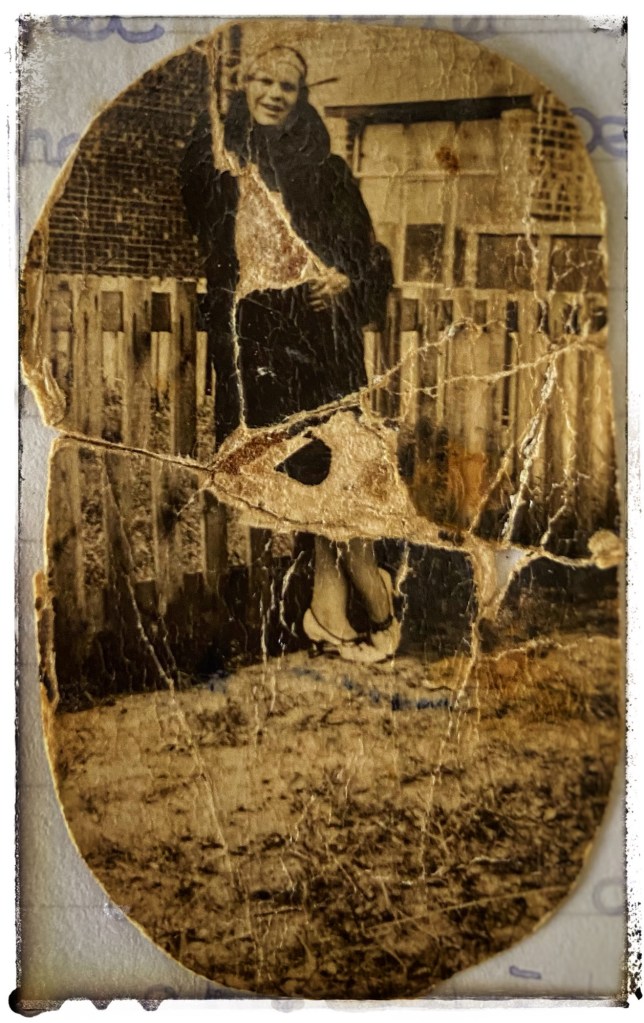
Today, 2 July 2024, ‘Big Nanny’, my maternal grandmother would have been 118 years old. This is the only photograph I have of Hilda May Edmonds, born at the dawn of the 20th century.
According to the 1911 Census of England and Wales, Hilda aged 4 lived at 123 Winson Street in the working class suburb of Winson Green with parents Robert, 39 and Mary, 41, brothers, Willey, 10 and Joseph, 8, and two boarders, James Aspinall, 71 and Margery Grattage, 3.
Hilda’s, Mom, Mary had given birth to five children, two were deceased. Ivy passed when 2 years old in 1901. I have not yet identified the other child.

Robert was employed as an art metal worker making fire screens. According to the 1891 census, art metal work had been his occupation since the age of 19. Robert had a background in metal, hailing from a family of brass founders and casters.

The Victorian terraced house no longer stands. It may have been a two up, two down plus attic bedroom facing the street with a rear courtyard containing a communal outside washhouse (laundry), and toilet connected to the sewer, a luxury, at that time for the less well off.
The house was located a hop skip and a jump south west of Winson Green Prison (the last execution was carried out in 1972), City Lunatic Asylum (became All Saints mental health Hospital), City Fever Hospital, and the Birmingham Union Workhouse. The Workhouse site later became Dudley Road Hospital.

I was unaware of my family’s connection to Winson Green when I was getting industry experience working for six months’ in one of the Dudley Road Hospital kitchens in 1984/85.
Hilda left home to marry Dennis Havelock Jones in 1928.
They lived in a 1920s house, 28 The Oval, Smethwick (promounced Smerrick), Staffordshire with children, Norman, Irene (my Mom), Denise, and Frank.
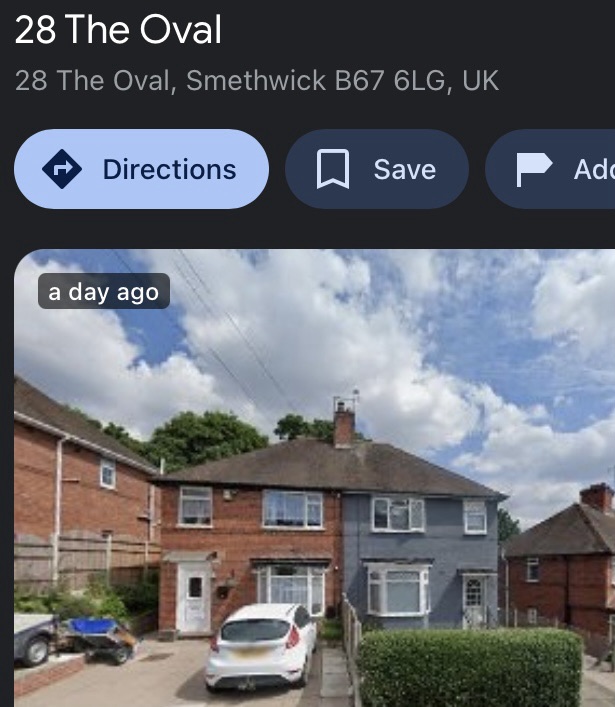
The eldest, Norman passed away due to gastroenteritis when 6 years old in 1934.

My Mom, Irene was born in 1935. This picture was taken on Mom’s first birthday. Mom contracted polio when she was 14 months old.
Mom recounted, before the start of the Second World War, Uncle Ben visited from America. He offered to take the children home with him, away from the anticipated bombing. The family decided to take their chances, the children stayed at home in England. Granddad built an Anderson Shelter in the back garden.
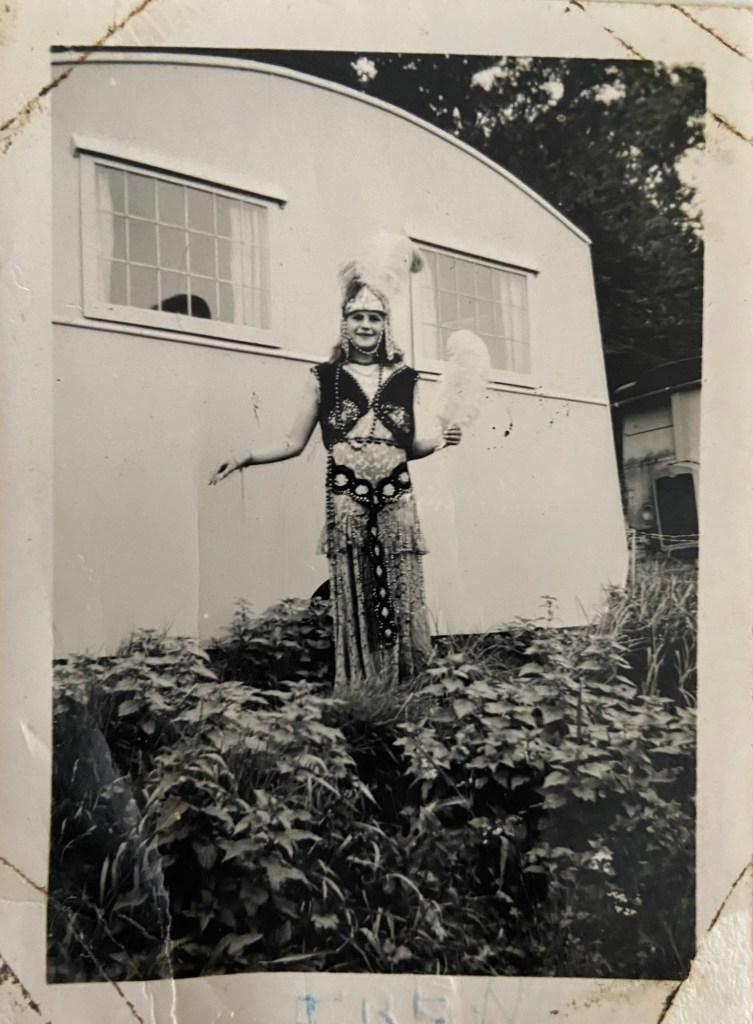
After the war, the family enjoyed holidays in a caravan built by Granddad. It was located in Bridgnorth, Shropshire on the bank of the River Severn. My Mom met my father, Trevor there, he had been camping nearby.
Denise’s husband of 4 years went off with another woman in 1962. It was too much for Denise, aged 23 to bear, she gassed herself by putting her head in the oven. My Mom and Uncle Frank found her slumped against the stove.
My Mom told me Nan was devastated by Denise’s death. She refused to leave her bed. My Mom and Dad agreed a grandchild was what Nan needed to lift her spirits.

This is where I entered the story in 1963.
I have only fond memories of my rotund, jolly, loving, type 1 diabetic, Big Nanny living with Granddad and their dog, Sue. I wonder, if Nan ever removed that hairnet and button up tunic she wore over her clothes. Maybe to go out in the blue Morris Minor van with Granddad.
I remember the semi detached house with a tiny entrance hall, a staircase ahead, and the front (best) room off to the left. It was used to receive visitors. My brother and I were not allowed to be in there without adult supervision.
The walls of the room were papered with a toile de jouy pattern.
A white Sylvac hyacinth mantle vase with wire flower holder insert stood on the bay window cill along with cast brass ladies wearing crinoline dresses.
A high back three piece suite, upholstered in dark grey with small burgundy crosses and topped with antimacassars faced a tiled fireplace with a gas fire. There was also a coffee table, hearth rug, and a potted aspidestra atop a tall timber plant stand.
I assume Granddad had modernised the panelled doors by adding hardboard and painting them white. Drive-in ball catches had also been installed. A shelved under stairs storage cupboard was accessed from next to an upright piano. The space had a small stained glass window looking into the lean-to garage at the side of the house.
Next to its door, another led to the kitchen. It was furnished with a large table, a small two seat sofa with wooden arms and green seat and back cushions in front of a fire, a dark red rag rug, a green enamelled gas stove with eye level grill, stainless steel sink with draining board and yellow Formica sliding door cupboards.
Nan would let me light the kitchen’s gas fire using a wooden spill from the pot on the tiled mantle. I was encouraged to help peel vegetables, shell peas and chop mint grown on Grandad’s allotment.
Granddad liked his sausages skinless so Nan would give the skins to me to take to Sue outside. I didn’t tell her, sometimes Sue shared her raw sausage casings with me.
As a treat, Nan would give me ‘a piece in the dip’. She used a long serrated knife with tiny teeth to slice the crust off a white tin loaf then dip its face into the juices of the Sunday roast. I would add ground white pepper and savour each mouthful of this prized gastronomic delight.
There was a huge glazed lean-to at the back of the house accommodating a workshop, toilet, and the laundry gadgets from across the decades including, a copper, washtub, dolly, and mangle. By the ‘60s Nan was using a gas powered washing boiler and an electric cylindrical spin drier. Monday was wash day in the Jones household.
Outside there was an old crock sink mounted on a stand both painted green and filled with red geraniums. A long lawn lined with orange marigolds stretched towards Grandad’s green painted shed and beyond a gate into Mrs Millington’s garden. A washing line stretched as far as the eye could see.
Up the narrow, steep staircase there were three bedrooms and a bathroom. The bathroom had dark brown linoleum floor covering, cream painted walls and gleaming white fittings with chrome taps. The taps, tee shaped from the side were connected through the back of the square porcelain sink and the end of the footed iron bath. The vertically mounted, cross headed taps had small white porcelain discs, indicating ‘hot’ and ‘cold’. There was resistence when turned, emitting grinding screeches followed by soft pops.
The water gushed from the bottoms of the taps with what seemed like the force of fire hoses, even though it took forever to be deep enough before I could climb into the gargantuan steaming vessel. Once inside, the bottom and sides would feel icy against my skin. Also, the enamel was a little rough from eons of scouring with Vim powder.
My last memory of my Big Nanny is from 1969. She was in bed in the best room. It had been brought downstairs as she was ill and there was no toilet inside the house. I took the gift of a dolly I had made from strands of pale blue wool.
Sadly, cancer of the liver got the better of Big Nanny, passing away on 5 January 1970, aged 63 when I was 6. The wool dolly accompanied her to her final resting place in Uplands Cemetary, Smethwick.
 theINFP