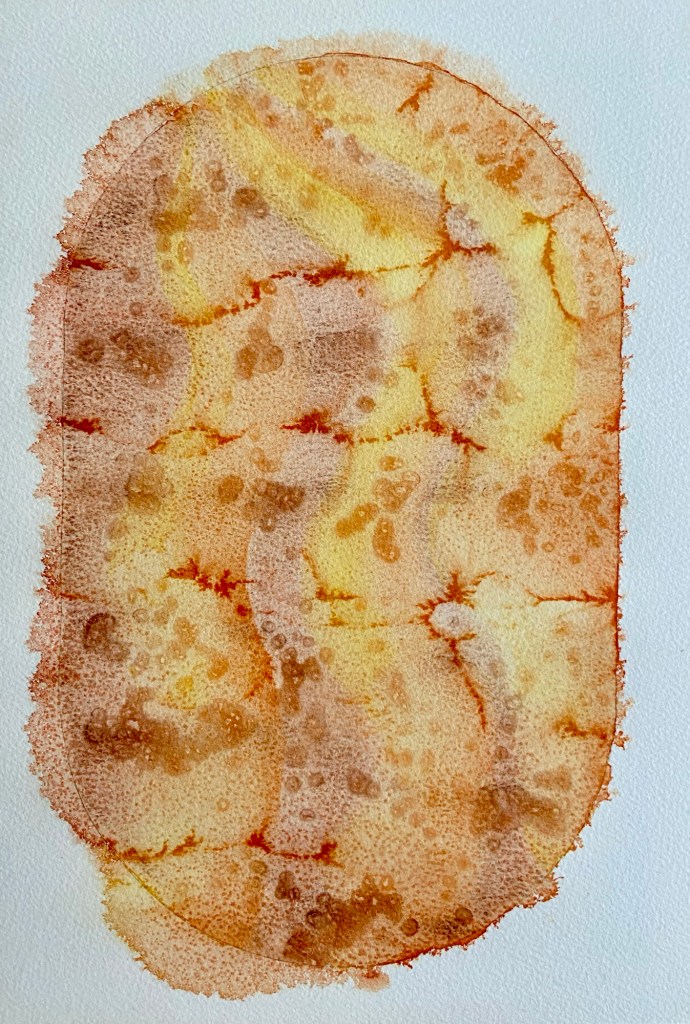
I had an idea of sinuous flames of ox blood, yellow, and orange flames undulating from the bottom of an oval to left of the top.
Spraying water and adding salt resulted in the above picture.
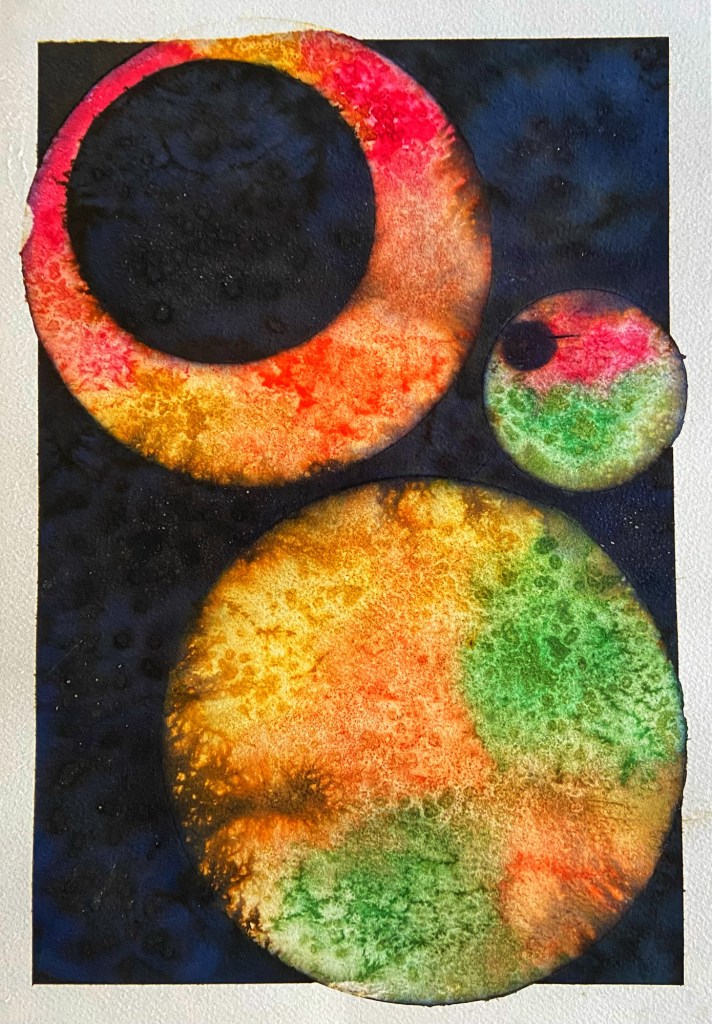
My husband suggested I try a circular watercolour that could be printed on a tee shirt. This abstract mixed media piece is the result from last weekend. Two washes intensified the colours.
This abstract mixed media painting was inspired by the colours of water over submerged sand islands viewed whilst descending towards Cairns off the coast of Far North Queensland, Australia.
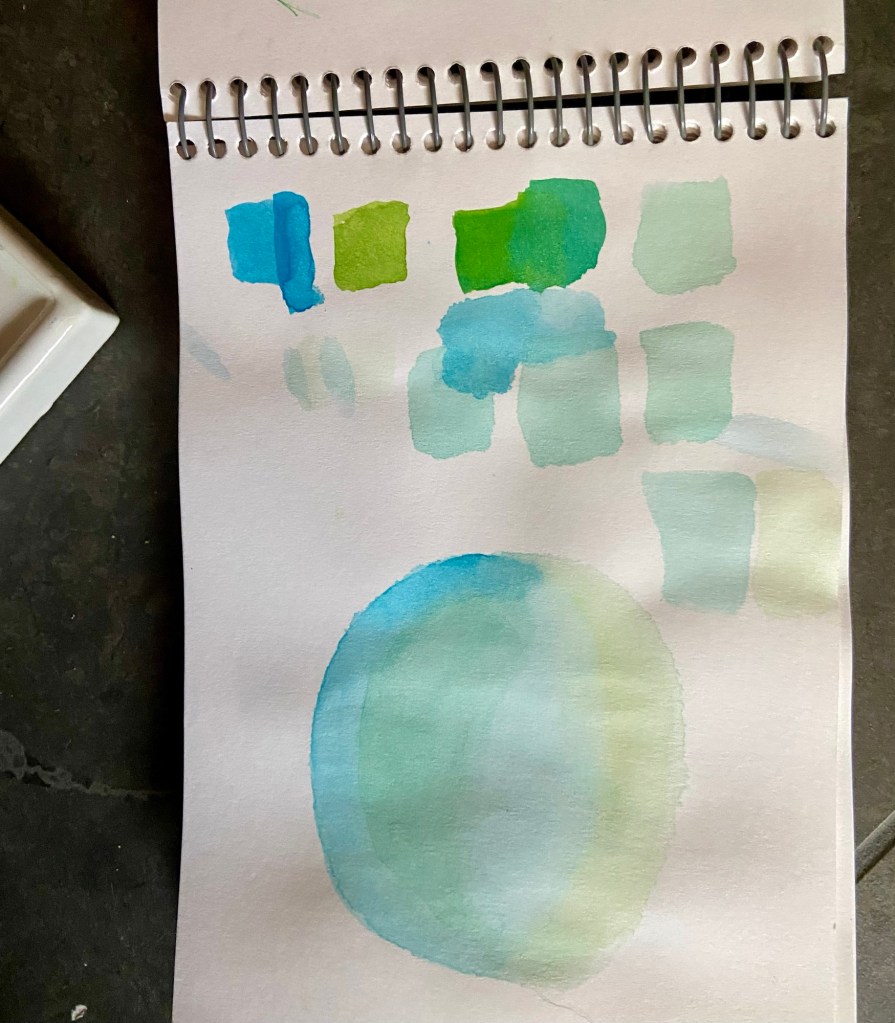
Concept sketch 1Concept sketch 2
Whilst on holiday in Port Douglas, using my husband’s 1980s Winsor and Newton Sketcher’s palette, I completed a couple of concept sketches on A6 cartridge paper.
After returning home, I started with a pencil oval outline filled with light watercolour washes in acqua, blue, and green. Texture was created by adding large clean salt crystals that absorbed the water and hues.
The outline was inked in and more washes added.
First draft
Water was sprayed on sections of the picture freeing up the colours to merge, and the edges and outline to soften. Darker shades were added to the water droplets and encouraged to flow into each other. Salt recycled from other paintings was added to create random patches of soft brown and pink.
The above was repeated a few times until the final version emerged.
As the seasons shift and leaves fall, the Earth recycles energy, converting it into new life and carrying it forward. Embrace the positivity you need to progress in life. Happy Samhain.
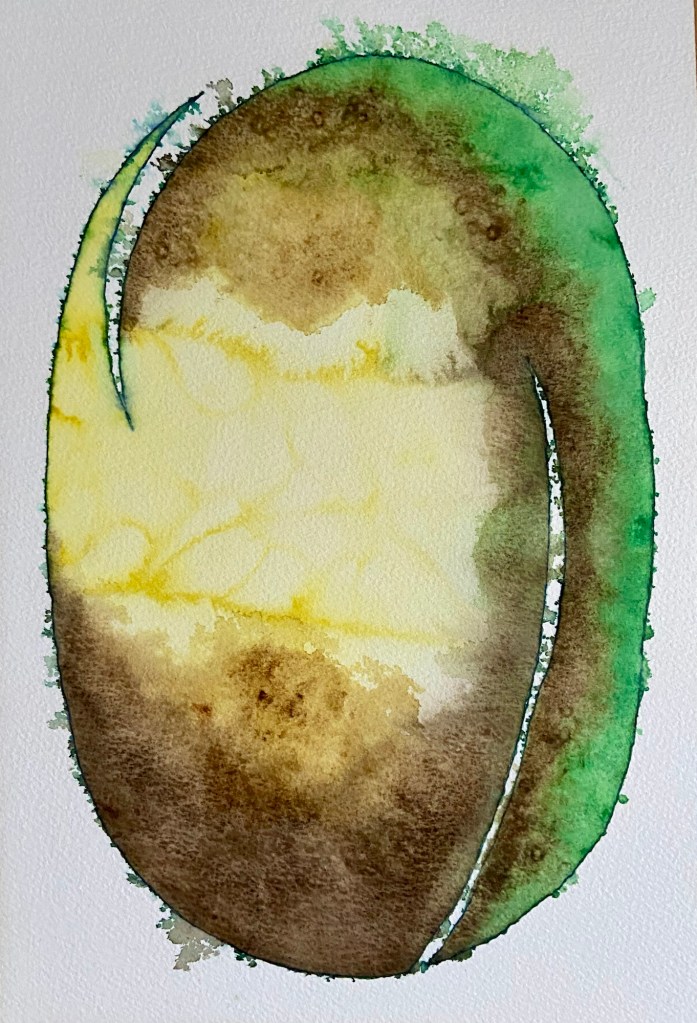
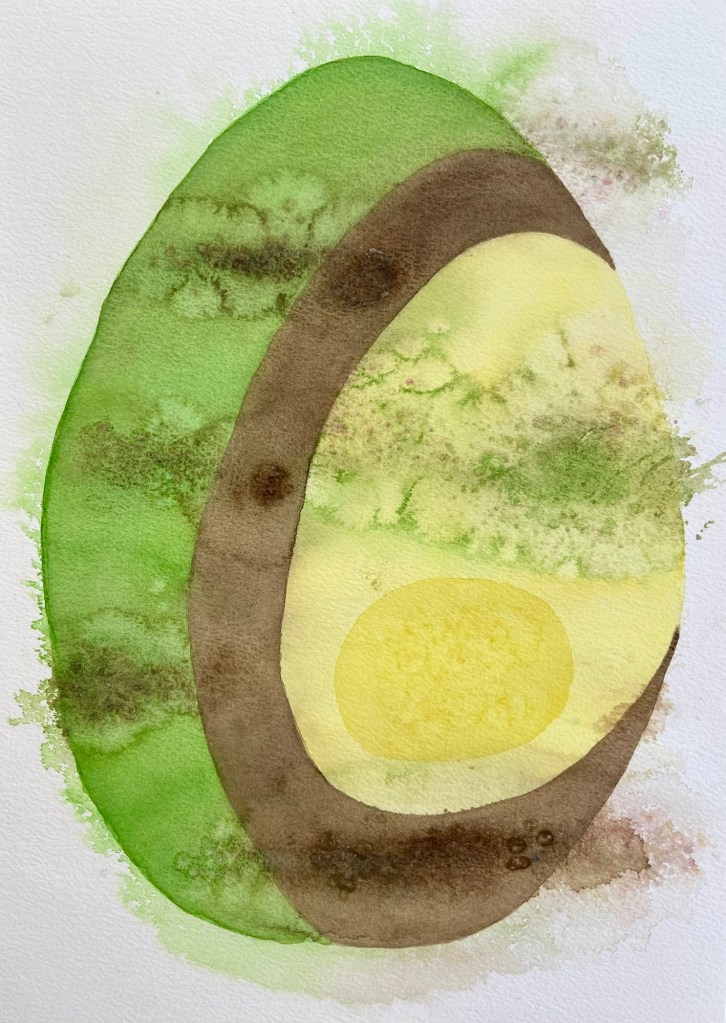
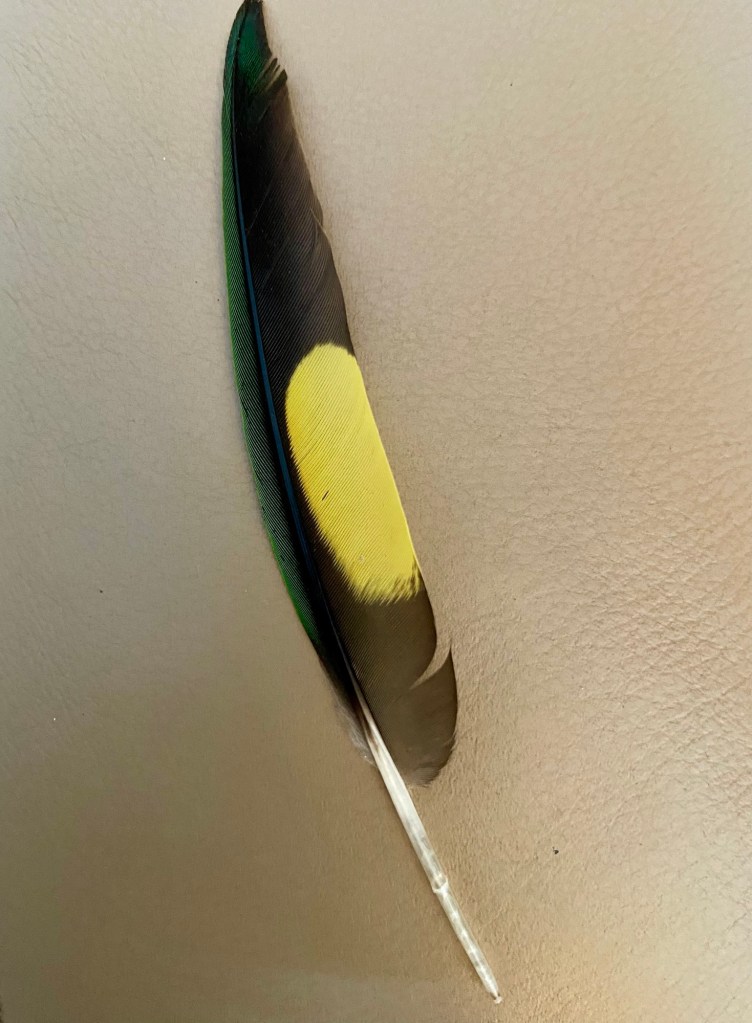
This is essentially green yellow brown no. 2. Inspired by a feather from my husband, the split on the left echos the way barbs separate. The shaft is represented by the right hand white curve from base to two thirds up.
The pristine blue ink outline was softened by spraying water onto the still wet Winsor and Newton watercolours.
Early on salt was added to the yellow area resulting in the undulations. After three layers of green and brown, salt was used to develop texture.
I am happier with the way this mixed media abstract painting came out. My husband said it looks like one of Jack’s beans that grew a mighty stalk linking his home with that of the giant.
Quite a while ago, in fact when exactly is vague, I designed a zigzag pattern using a watercolour brush in a painting app on my iPad. Its purpose was specific, the background panel for the title block on this blog.
My husband returned home from walking Stan with the gift of a feather. We think it is from a rainbow lorikeet because of the green and yellow colours. I decided to use it as inspiration for a watercolour.
Being fond of ovoids, I sketched out an idea and painted the first wash. A few more layers followed.
Horizontally, it looked a bit like a misshapen footy ball. In portrait it resembles an avocado. At this point, I sprayed water onto it. A soft outline formed from the wet edge. Rivulets of colour settles in the warped dips of the contorted paper. I added reused salt crystals and left it to dry overnight.
The zigzag pattern remained in the back of my mind during the process.
I added the darker yellow oval, fresh salt and darker areas to the green and brown topped with recycled salt.
When travelling to and from work, I have backpacked: laptop, headset, headphones, compact umbrella, face masks, cotton bags, hand sanitisers, tissues, wallet, keys, key card, pens, pencils, eraser, sketchbook, propelling pencil. When possible, capture moments. The following and sketch above filled fifty minutes.
when one is really quite weary how dreary dearie surreptitiously seeking inspiration questions no right asking even if strong featured person opposite is known consciously combined cosmetics for commuting? muted tones without shading to avoid notice? only one or one of many masks?
Last Saturday, having gazed at the bookcase from my chair, I was inspired to create something using three ceramic pieces modelled on nature. A leaf, a shell adorned cornucopia, and a hyacinth leaf vase.
I arranged and drew around the objects in pencil then ink. I decided on purple for the cornucopia using the colour of mussel shell for inspiration, predictably green for the leaf, and finally orange for the vase.
On Sunday, I thought the shapes I had chosen worked well together as there was movement between them from the colours intermingling. Wishing to add depth and luminance, I added yellow washes to the orange and green and redid the ink outline.
After deciding the abstract picture was called harmony in nature, I added three black undulating lines to ground and orientate the central image.
This was my first foray into fountain pen ink sketching and an ink wash. The Parker Qink dried extremely quickly. I diluted it, painting onto dry paper.
The ink is from a time of my youth in the 1980s, the Parker Sonnet pen, a gift from work colleagues when we left the UK to emigrate to Australia in 1998.
My naïveté continues to be a theme. I had not considered the inked lines would run when with watercolour was added. I worked with it.
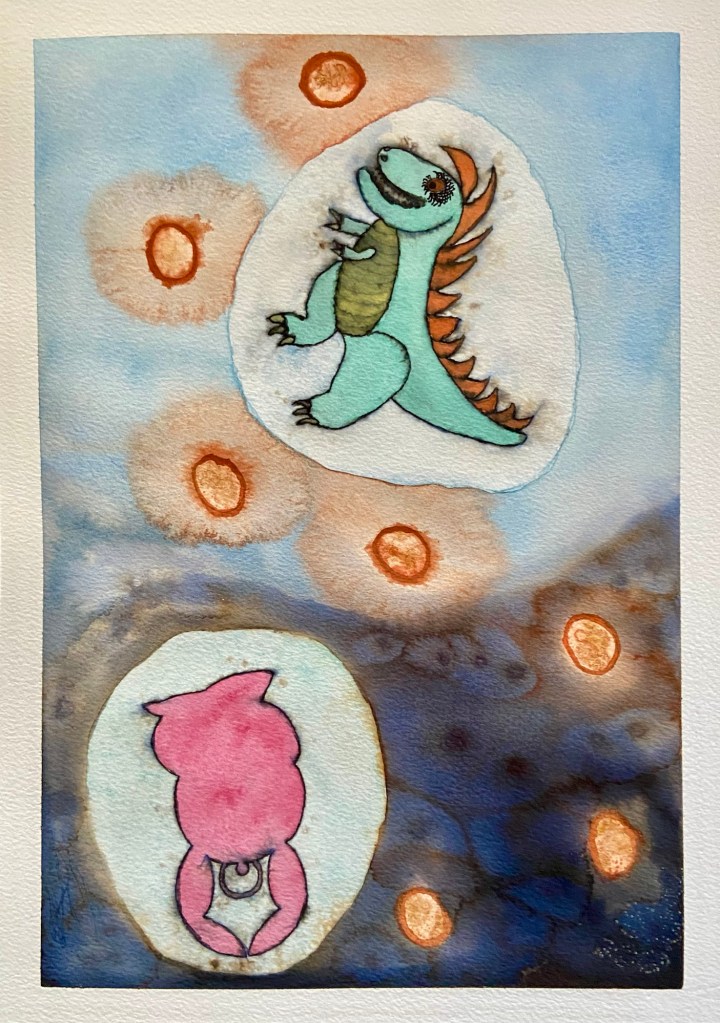
Aging and some of the medication I take have a side effect of shaky hands. I used one of my pencil sketches of a dinosaur. I cut the sketch out, pencil shaded the outline and inked in the outline.
The painting developed as it was created.
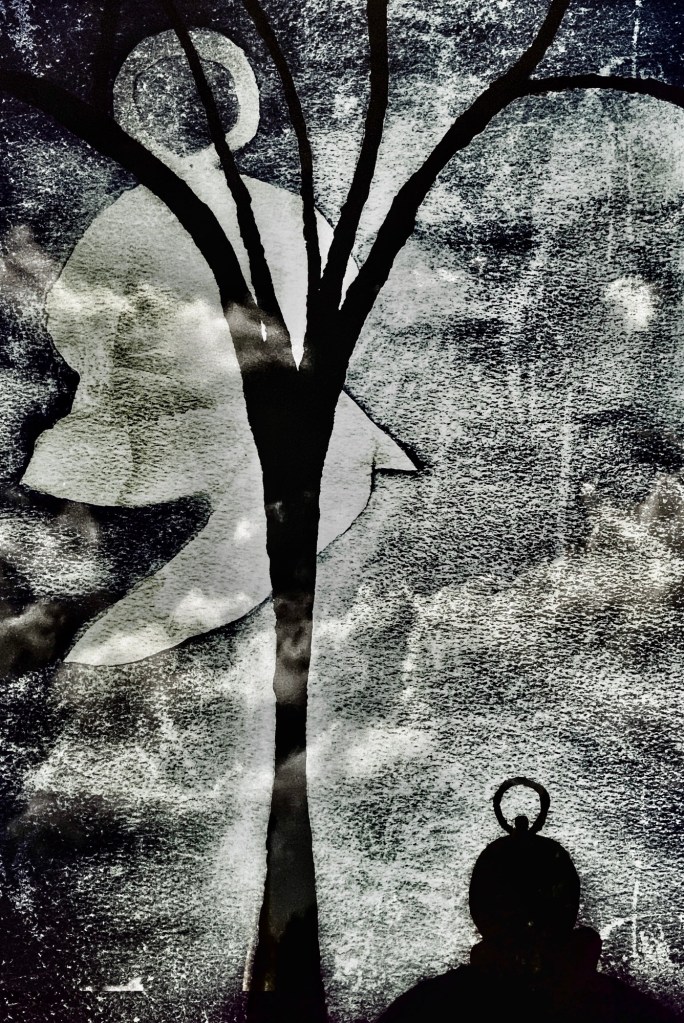
Salt was added to the night sky, the background of the ovoid contained figures, and the centre of the seven orange shapes. They represent one thousand miles markers across the Pacific Ocean and the equator from South East Queensland to California.
It is night time where I am, represented by pink Airhead. I engage with my blogging buddy Ra as Rawr the dinosaur through thoughts, dreams, and engaging with each other’s work.
The painting can be viewed with night at the bottom or the top.
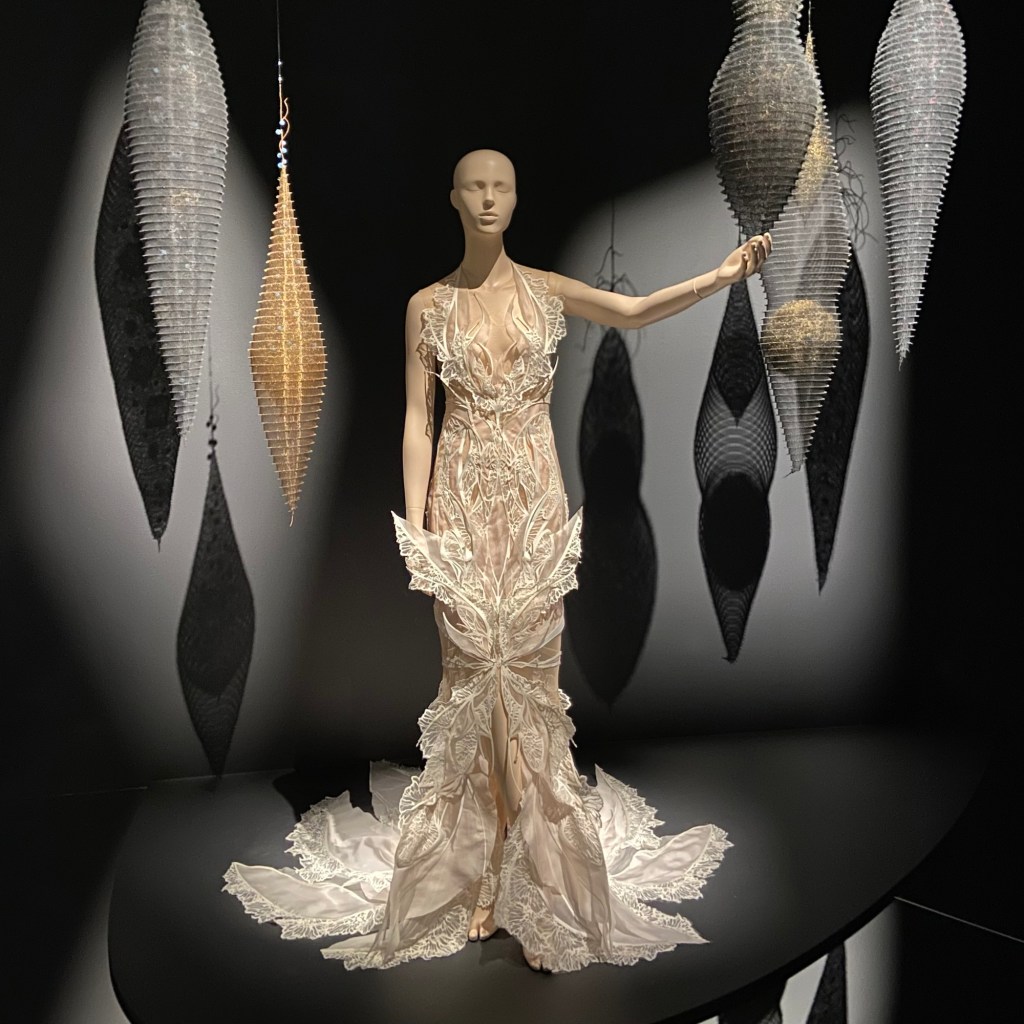
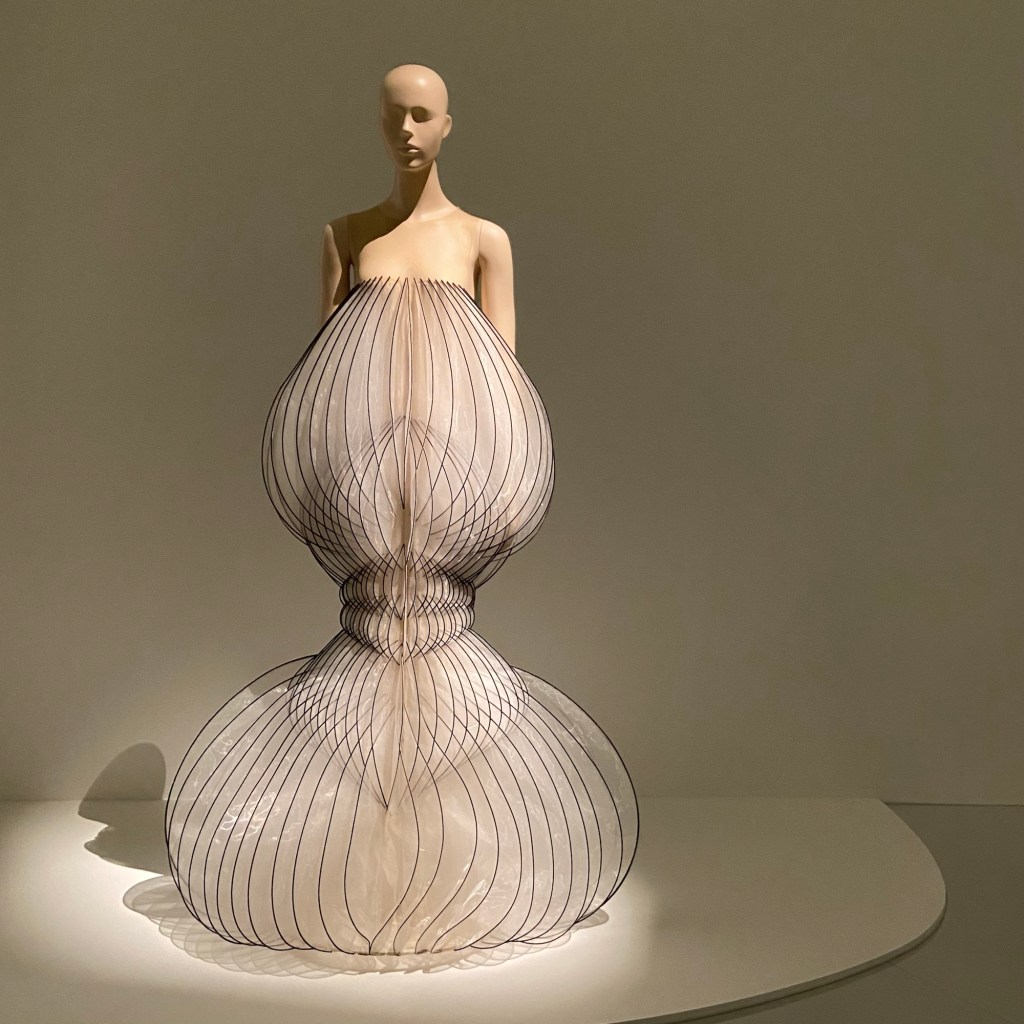
Inspired by the 21st century couturier, Iris van Herpen at Queensland’s GOMA (Gallery of Modern Art), Brisbane, I present a modest collection of organic poems and images from the exhibition.












 theINFP