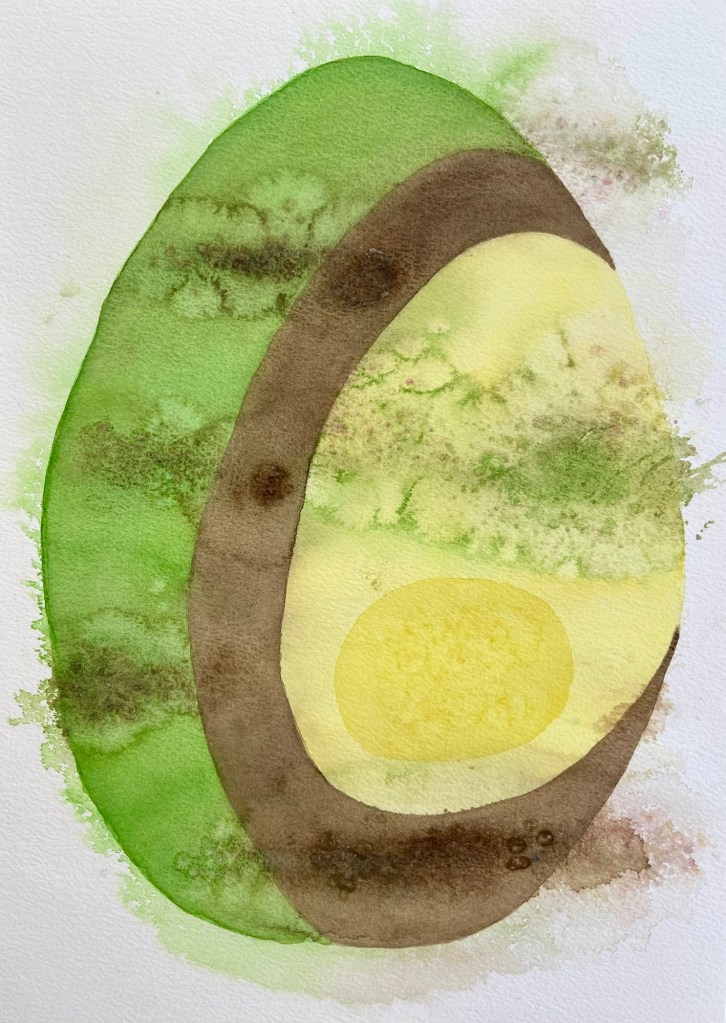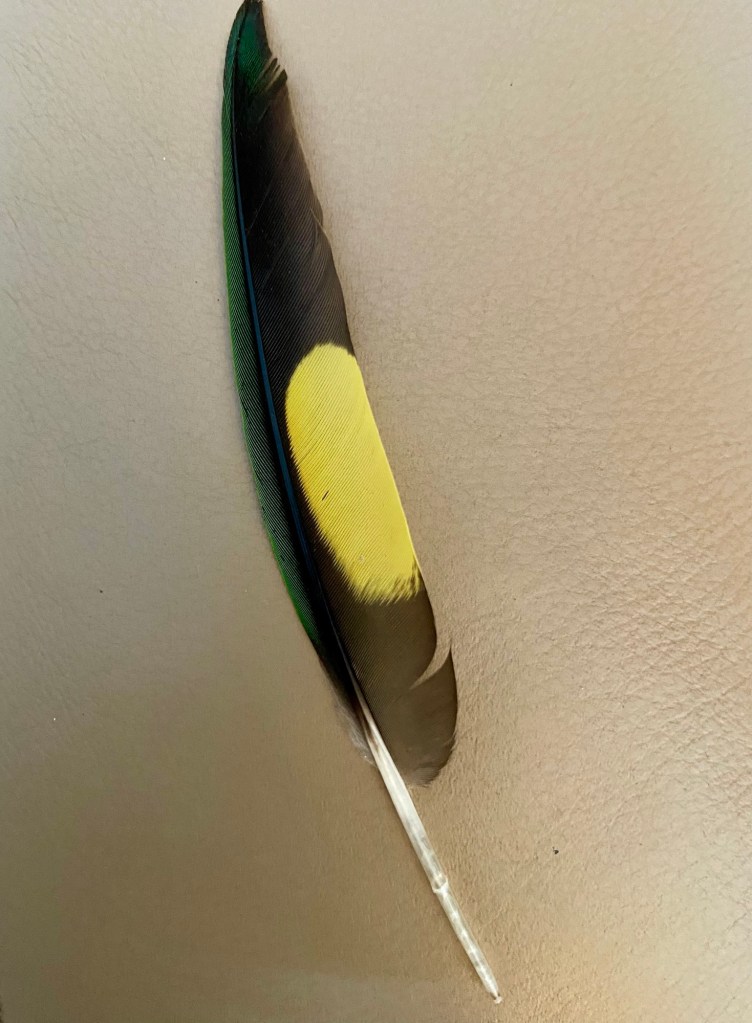
Emerge from Central gloom into a brash world. Persevering down pain filled steps, Hunched against chilly drizzle, I am engulfed by swishing traffic And beep beep crossing noises To traverse Creek Street.
Epiphanic; time and raindrops slow Gaze catches a leaf of coffee shade Resolutely reclining in the gutter. Dew bejewelled before dusky rose kerb Gold, ruby, sapphire, amethyst Shimmering in the spartan morning rays.
In minds eye, the moment lingers While crossing over Ann Street, During descent of Creek Street, And left into Adelaide Street, Ad infinitum The image remains to this day.
When we arrived in Queensland six years ago we were introduced to the quirky mayhem of Drag Queen, Scarlett Fever at the Beat Megaclub, Fortitude Valley on a quiet Sunday night. I was struck by the originality and grace of this gazelle like performer.
Scarlett Fever, 2024
Nowadays, connecting with our gay tribe is limited to discrete preplanned visits to Brisbane.
Last night, I was thrilled to see Scarlett Fever at the busy Wickham hotel. Scarlett’s eyes and character have grown into the wonderful contemporary artist they are today.
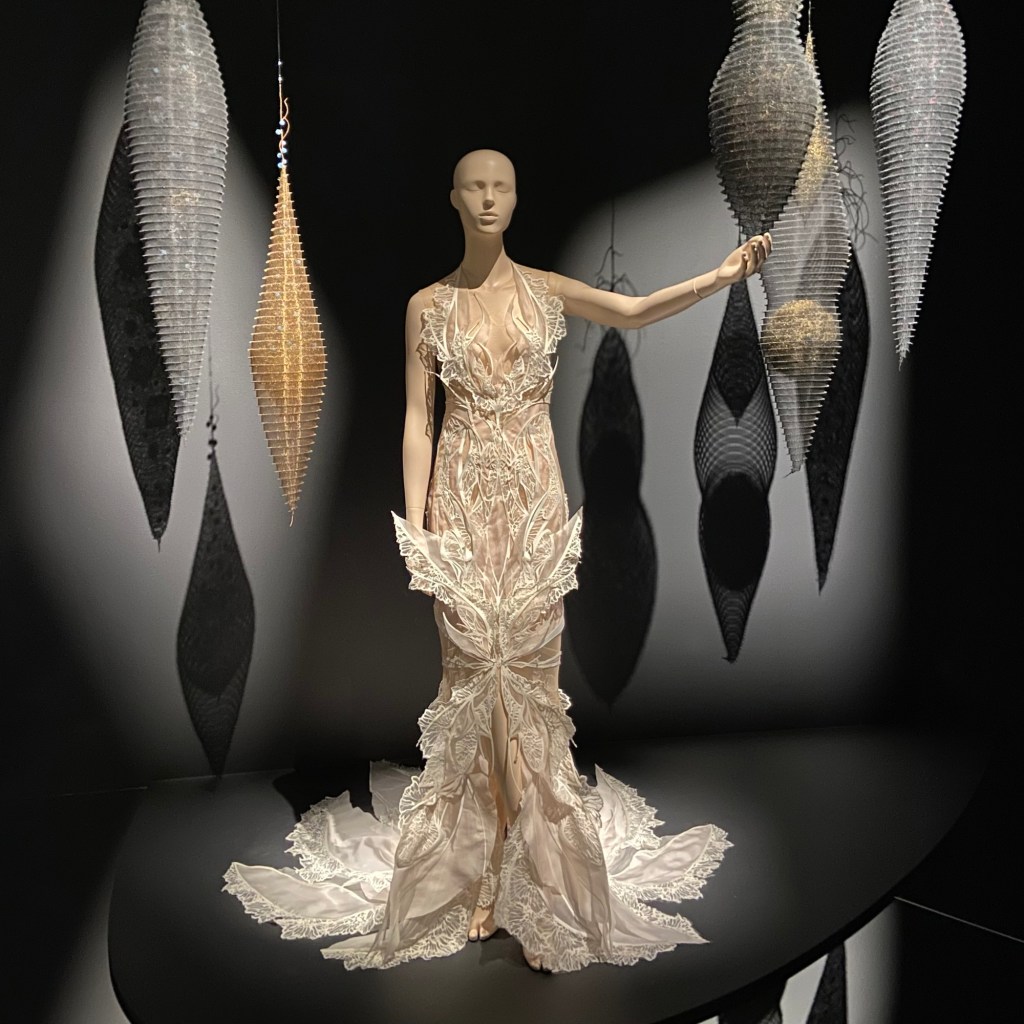
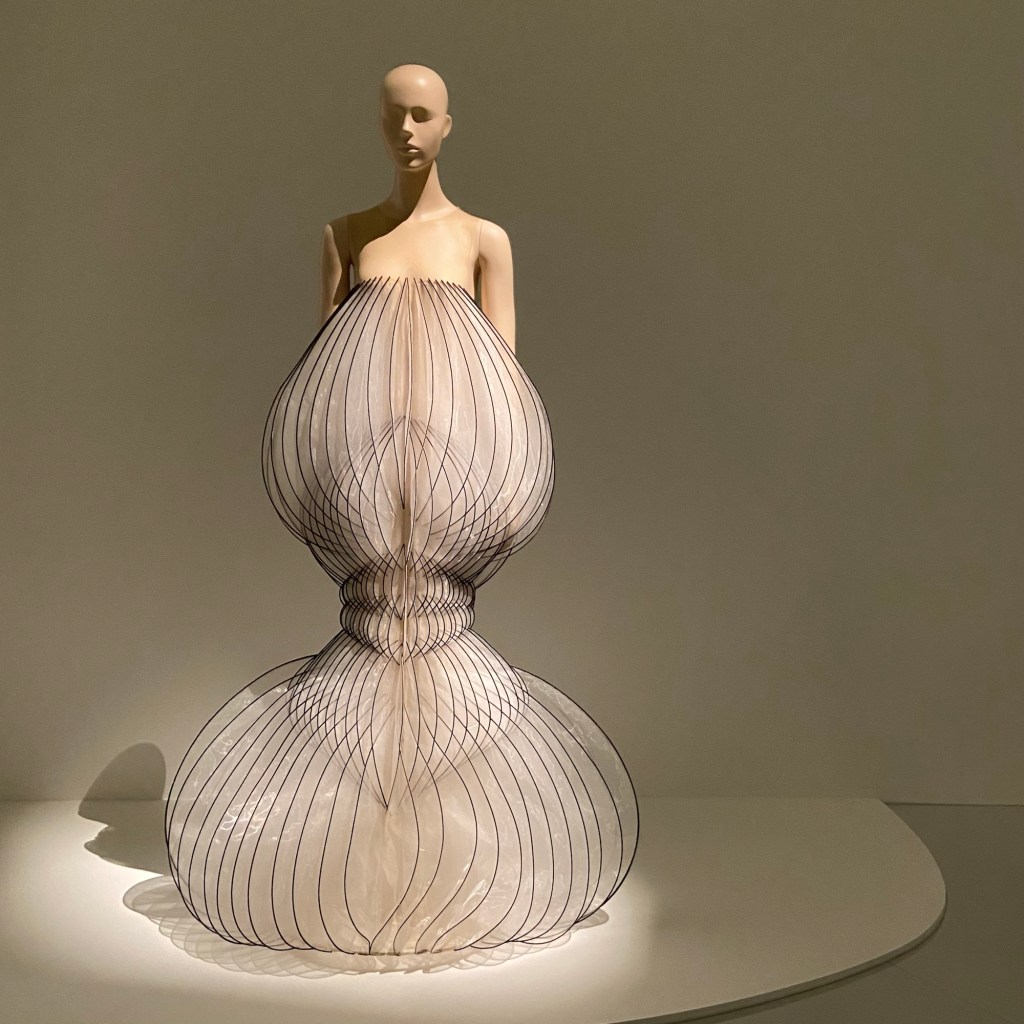
Inspired by the 21st century couturier, Iris van Herpen at Queensland’s GOMA (Gallery of Modern Art), Brisbane, I present a modest collection of organic poems and images from the exhibition.
For the last two years I have been in a state of threat at work. While the employer proclaims it is a place of inclusion and authenticity, I wonder if this statement relates only to the loud and pushy at the expense of others. Perhaps I am not resilient enough, unwilling to speak out, and too sensitive.
When my values were tested too much, I fought back (in a shy introverted way). I was labelled ‘emotional’. I resorted to my go to fawn response with underlying frustration and at times anger. I aimed to please and appease by sacrificing myself.
Over the last twelve months, somehow, I sustained this tiring performance, achieving a personally unnecessary glowing annual performance review. Satisfactory would have been enough.
When I recently found out the perpetrator was being reassigned, I felt numbness and disbelief.
I developed fawning from ages 9 to 16 years. The seemingly constant aggression directed at my mother and brother by my first stepfather brought firsthand experience of rage, domestic violence, and abuse. I largely kept my thoughts and feelings to myself. Withdrawing my marshmallow being behind a protective shell. As soon as I was able, I fled away to college.
At the beginning of this week, perpetrator free, I felt like a huge weight had lifted from my shoulders.
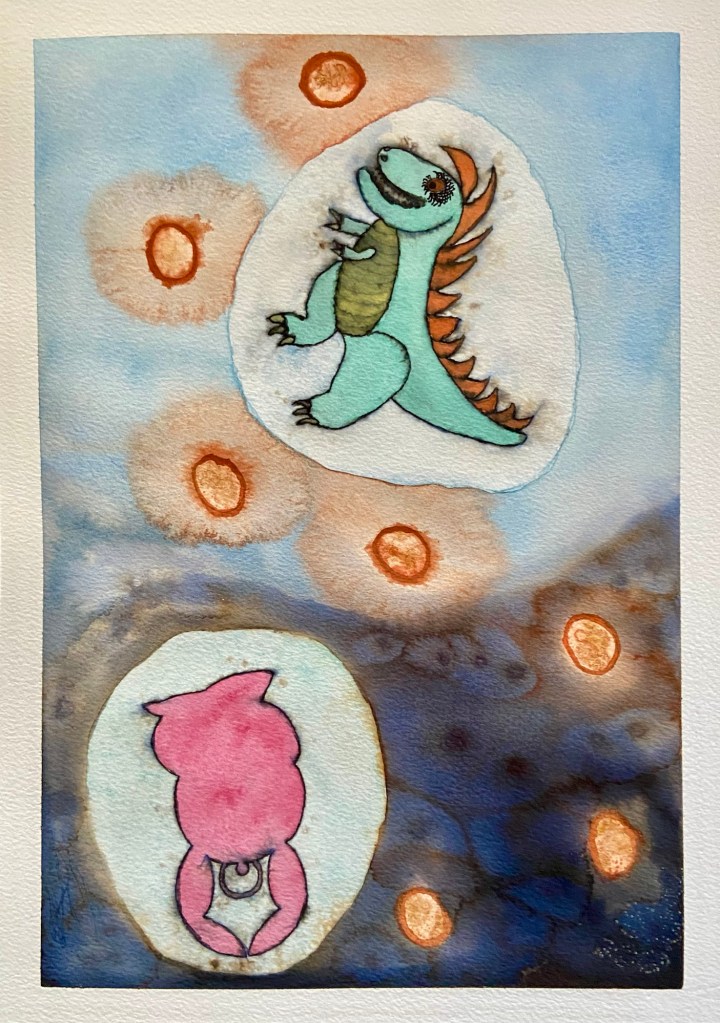
This painting reflects pleasing and appeasing while dark emotions and discontent underlaid my view of my workplace. The grey background represents compromise, neutrality, control, and practicality. I am represented by an anonymous outward facing ovoid, outlined with dark blue and red inks. The teal inner self displays responsiveness, integrity, and practicality. It contains pink organic shapes of kindness, caring, and compassion; essential for my role. Salt adds fractures to the composition.
In my late teens and early twenties, I experienced hospitality working as a casual, selling fish and chips at Neptune’s Pantry, as a banqueting waiter at the Raven, hall porter at the Chateau Impney, and barman/porter/night manager at the Windermere Hydro hotels.
After completing college in 1984, I was disillusioned by the prospect of working long hours in a hotel for the rest of my life. Back at home in Droitwich, I looked at other options. A newspaper advertisement for a full time position in retail caught my eye. Mom drove me the six miles to Worcester for the interview. It was supposed to take 20 to 30 minutes.
The manager, Michael Dray had me describe the selling features of a fawn Italian leather high heel shoe with a gold piped darker tone lizard skin inverted chevron at the top of the counter (behind the heel). At the time, this shoe was the most expensive in the shop, around £250 in 1984, equivalent to £1000 today.
After spending about two hours with Mr Dray and returning to the car, Mom was both happy I got the job and unhappy for having to wait for me without knowing what was taking so long.
These mixed emotions transferred to me as happiness and anxiety, throughout my employment at R&B. My work colleagues were a wonderful mix, ranging from elder and younger sister types to the outrageous. Other than the manager, I was the only male employee.
Our employment rewarded us with an hourly rate plus a percentage of sales commission. I had not considered the pressure weekly sales targets would have on me. It was calculated using the performance of the store for the same week in the previous year plus a mark up and divided between the number of employees working.
Other incentives included, ends of lines having a ‘spiff’ sticker attached to the box. The colour translated to a one-off £ value paid in addition to commission.
Every person entering the emporium was a prospect who should not be allowed to leave until a purchase had been made. If they were interested in slippers, it was expected, we introduce a matching handbag, polish, shoe trees, signing up for a store card, boots, shoes; you get the picture.
Whilst I had experienced the need to perform at school and college through achieving the requisite grades to graduate, sales was and still is an anathema to me. Anything more than charming, chatting, and cheering on when I disagree with what I am doing leads to poor performance. A completed store card application that passed credit checking earned £1 for the sales assistant and potentially a life of debt for the shopper. In the six months or so I spent at R&B, I did not once achieve my sales target.
Today, I am surprised by my naivety of not thinking things through before jumping headlong into them. In hindsight, I learn through failure by picking myself up and trying something new.
Back to the happy times at R&B, through the ladies collection, my eyes were opened to a world of coloured leathers including, navy, white, cerise, Capri, taupe, chocolate, salmon, raspberry, lemon, lime, emerald, ruby, claret, sapphire, opal, silver, gold, bronze. The men’s mainstay of black and brown occasionally branched out into silver or mid grey, tan and, blue.
I used every opportunity to try on ladies and men’s shoes that took my fancy. I fell into the role of clown, parading around the stock rooms, much to the delight of my coworkers.
We purchased our own uniforms. Males wore a suit with shirt and tie. My female counterparts an outfit selected by the floor supervisor, a tall slim, Miss Dixon. It changed twice per year and did not suit all body shapes.
A condition of our service was the wearing of a pair of ‘shop shoes’ from the company’s range for six months. They were not allowed to leave the premises. Our bags were checked every time we went out. We paid a quarter of the retail price. I chose a £100 pair of tan Moreschi tasselled half brogue loafers with a grosgrain vamp.
During my time there, I attended a course on fitting children’s shoes in Norwich at the Startrite factory so that I could assist during busy back to school periods.
My work mate, Tracey ‘ace face’ Melling ran the children’s department on the mezzanine. Outside work, a goth with backcombed hair, ripped black clothing, and black, white, and purple makeup. Each day, Tracey drew on eyebrows after arriving late to work. I still smile at the thought of the surprised faces of children and parents looking at Tracey without eyebrows or with only one drawn on.
Tracey was hugely creative. During a quiet period, Tracey drew pencil sketches of pigs wearing R&B shoes on the back of Clarks packing labels. I was gifted with the sketches which I copied to paint corresponding watercolours.
I began at R&B during the period of the Autumn/Winter uniform of black skirt and dark raspberry blouse.
Spring/Summer followed, Capri skirt with blouse of splodges of blue, pink, and green.
Fully utilising a 25% discount, my shoe collection grew to include leather soled and lined canvas shoes in two tone blue and in fawn; polished burgundy, black, dark brown, and dark fawn suede brogues, tan boxer boots, the list goes on. Only the Moreschis remain.
A year on from moving house we are starting to declutter. A portfolio of drawings and paintings from the ‘80s were rediscovered
I lived on the north shore, Blackpool, Lancashire, UK during the off seasons 1982 to 1984 whilst studying hospitality management at Blackpool and Fylde College of Higher and Further Education.
Wild weather frequently lashed the esplanade. I painted this watercolour was from a photograph of the North Pier taken on a calm day as the sun was descending.
WordPress informed me this is my 1000th post, wow!
Today, 2 July 2024, ‘Big Nanny’, my maternal grandmother would have been 118 years old. This is the only photograph I have of Hilda May Edmonds, born at the dawn of the 20th century.
According to the 1911 Census of England and Wales, Hilda aged 4 lived at 123 Winson Street in the working class suburb of Winson Green with parents Robert, 39 and Mary, 41, brothers, Willey, 10 and Joseph, 8, and two boarders, James Aspinall, 71 and Margery Grattage, 3.
Hilda’s, Mom, Mary had given birth to five children, two were deceased. Ivy passed when 2 years old in 1901. I have not yet identified the other child.
Approximate location of the house
Robert was employed as an art metal worker making fire screens. According to the 1891 census, art metal work had been his occupation since the age of 19. Robert had a background in metal, hailing from a family of brass founders and casters.
Typical Victorian house plan
The Victorian terraced house no longer stands. It may have been a two up, two down plus attic bedroom facing the street with a rear courtyard containing a communal outside washhouse (laundry), and toilet connected to the sewer, a luxury, at that time for the less well off.
The house was located a hop skip and a jump south west of Winson Green Prison (the last execution was carried out in 1972), City Lunatic Asylum (became All Saints mental health Hospital), City Fever Hospital, and the Birmingham Union Workhouse. The Workhouse site later became Dudley Road Hospital.
Winson Green at the turn of the century
I was unaware of my family’s connection to Winson Green when I was getting industry experience working for six months’ in one of the Dudley Road Hospital kitchens in 1984/85.
Hilda left home to marry Dennis Havelock Jones in 1928.
They lived in a 1920s house, 28 The Oval, Smethwick (promounced Smerrick), Staffordshire with children, Norman, Irene (my Mom), Denise, and Frank.
The grey house is no. 28, Google street view
The eldest, Norman passed away due to gastroenteritis when 6 years old in 1934.
My Mom, Irene was born in 1935. This picture was taken on Mom’s first birthday. Mom contracted polio when she was 14 months old.
Mom recounted, before the start of the Second World War, Uncle Ben visited from America. He offered to take the children home with him, away from the anticipated bombing. The family decided to take their chances, the children stayed at home in England. Granddad built an Anderson Shelter in the back garden.
12 year old Mom in fancy dress outside the caravan
After the war, the family enjoyed holidays in a caravan built by Granddad. It was located in Bridgnorth, Shropshire on the bank of the River Severn. My Mom met my father, Trevor there, he had been camping nearby.
Denise’s husband of 4 years went off with another woman in 1962. It was too much for Denise, aged 23 to bear, she gassed herself by putting her head in the oven. My Mom and Uncle Frank found her slumped against the stove.
My Mom told me Nan was devastated by Denise’s death. She refused to leave her bed. My Mom and Dad agreed a grandchild was what Nan needed to lift her spirits.
This is where I entered the story in 1963.
I have only fond memories of my rotund, jolly, loving, type 1 diabetic, Big Nanny living with Granddad and their dog, Sue. I wonder, if Nan ever removed that hairnet and button up tunic she wore over her clothes. Maybe to go out in the blue Morris Minor van with Granddad.
I remember the semi detached house with a tiny entrance hall, a staircase ahead, and the front (best) room off to the left. It was used to receive visitors. My brother and I were not allowed to be in there without adult supervision.
The walls of the room were papered with a toile de jouy pattern.
A white Sylvac hyacinth mantle vase with wire flower holder insert stood on the bay window cill along with cast brass ladies wearing crinoline dresses.
A high back three piece suite, upholstered in dark grey with small burgundy crosses and topped with antimacassars faced a tiled fireplace with a gas fire. There was also a coffee table, hearth rug, and a potted aspidestra atop a tall timber plant stand.
I assume Granddad had modernised the panelled doors by adding hardboard and painting them white. Drive-in ball catches had also been installed. A shelved under stairs storage cupboard was accessed from next to an upright piano. The space had a small stained glass window looking into the lean-to garage at the side of the house.
Next to its door, another led to the kitchen. It was furnished with a large table, a small two seat sofa with wooden arms and green seat and back cushions in front of a fire, a dark red rag rug, a green enamelled gas stove with eye level grill, stainless steel sink with draining board and yellow Formica sliding door cupboards.
Nan would let me light the kitchen’s gas fire using a wooden spill from the pot on the tiled mantle. I was encouraged to help peel vegetables, shell peas and chop mint grown on Grandad’s allotment.
Granddad liked his sausages skinless so Nan would give the skins to me to take to Sue outside. I didn’t tell her, sometimes Sue shared her raw sausage casings with me.
As a treat, Nan would give me ‘a piece in the dip’. She used a long serrated knife with tiny teeth to slice the crust off a white tin loaf then dip its face into the juices of the Sunday roast. I would add ground white pepper and savour each mouthful of this prized gastronomic delight.
There was a huge glazed lean-to at the back of the house accommodating a workshop, toilet, and the laundry gadgets from across the decades including, a copper, washtub, dolly, and mangle. By the ‘60s Nan was using a gas powered washing boiler and an electric cylindrical spin drier. Monday was wash day in the Jones household.
Outside there was an old crock sink mounted on a stand both painted green and filled with red geraniums. A long lawn lined with orange marigolds stretched towards Grandad’s green painted shed and beyond a gate into Mrs Millington’s garden. A washing line stretched as far as the eye could see.
Up the narrow, steep staircase there were three bedrooms and a bathroom. The bathroom had dark brown linoleum floor covering, cream painted walls and gleaming white fittings with chrome taps. The taps, tee shaped from the side were connected through the back of the square porcelain sink and the end of the footed iron bath. The vertically mounted, cross headed taps had small white porcelain discs, indicating ‘hot’ and ‘cold’. There was resistence when turned, emitting grinding screeches followed by soft pops.
The water gushed from the bottoms of the taps with what seemed like the force of fire hoses, even though it took forever to be deep enough before I could climb into the gargantuan steaming vessel. Once inside, the bottom and sides would feel icy against my skin. Also, the enamel was a little rough from eons of scouring with Vim powder.
My last memory of my Big Nanny is from 1969. She was in bed in the best room. It had been brought downstairs as she was ill and there was no toilet inside the house. I took the gift of a dolly I had made from strands of pale blue wool.
Sadly, cancer of the liver got the better of Big Nanny, passing away on 5 January 1970, aged 63 when I was 6. The wool dolly accompanied her to her final resting place in Uplands Cemetary, Smethwick.