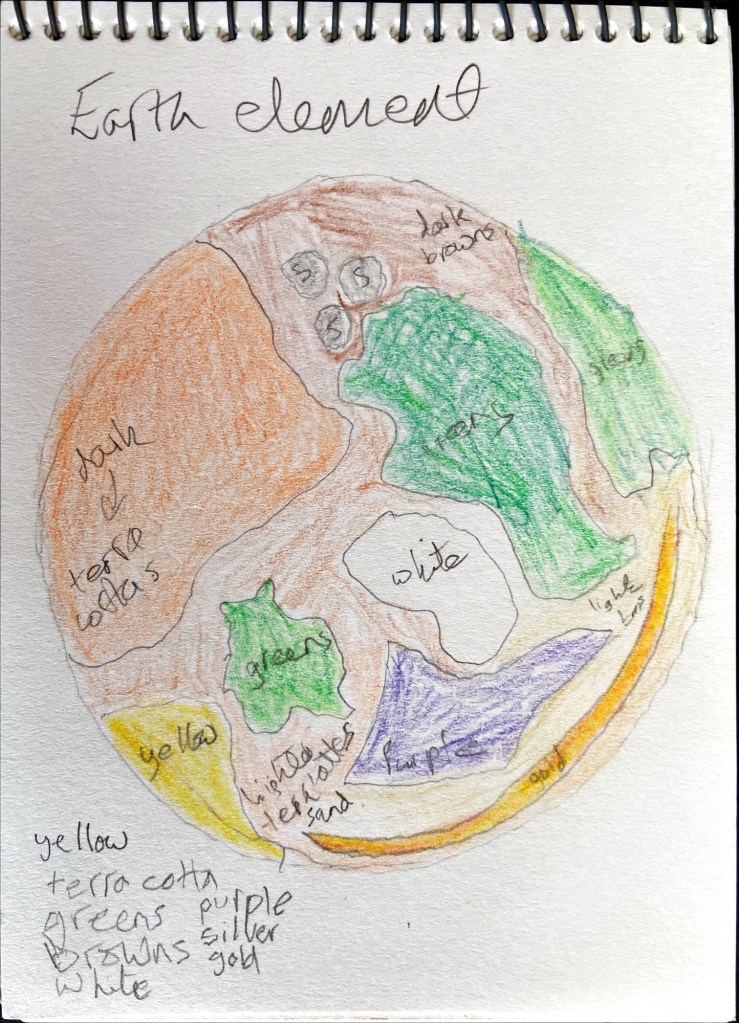
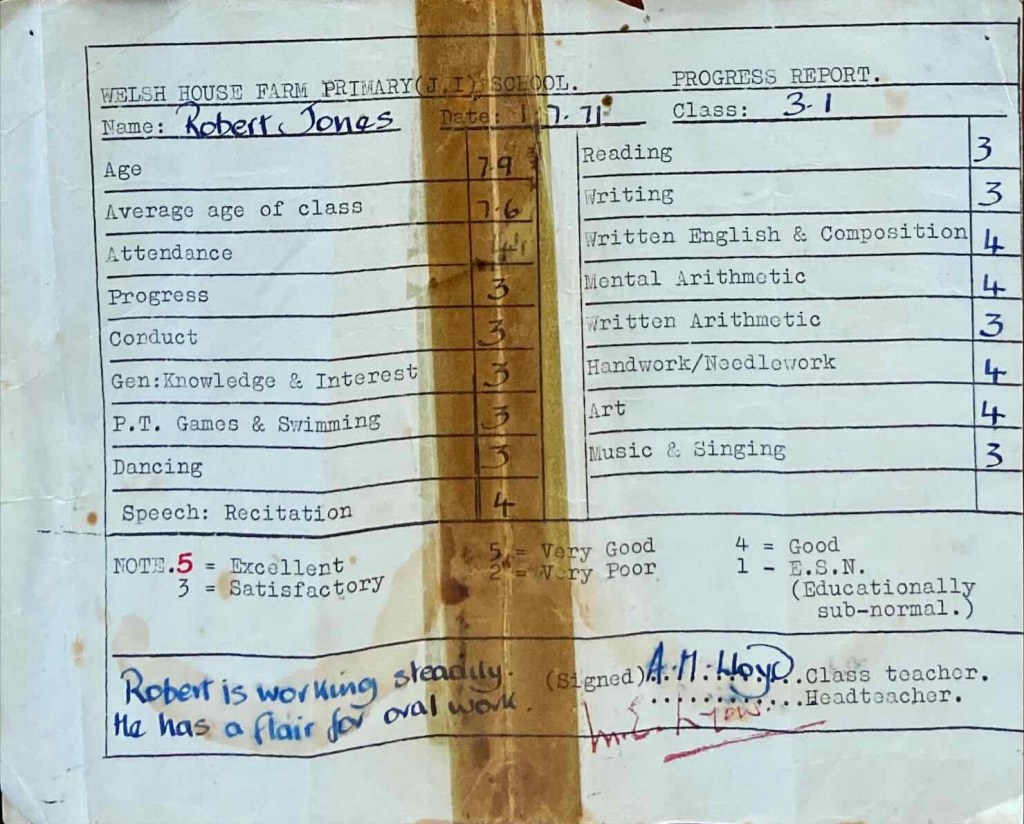
As I am working on a concept for an abstract watercolour earth element painting, carrying on from last week, I decided to share a couple more primary school reports.
I have no recollection of class 2.
From the above, it appears class 3 was split into two terms. The first was taught by Mrs Elway whom I adored. Mrs Elway played the upright piano in the school hall. It had an elaborately embroidered drop cloth affixed to the back of it.
My technicolor memory of Mrs Elway merges with the black and white film ones of English actress Margaret Rutherford. They both appeared to be nurturing, driven, crone spirits.
There were no excellent scores in class 1. At 6 3/4 my performance had markedly improved.
I don’t know why I missed 43 days of school other than having measles, chicken pox, and debilitating bouts of tonsillitis culminating in having them removed at the grand terracotta brick Ear Nose and Throat Hospital, junction of Edmund and Barwick streets, Birmingham.
After getting over the pain of healing wounds, I loved being in hospital. I have vivid memories of the late Victorian ward with beds either side of a central aisle with a table in the middle for meals. I loved the jelly and ice cream they served post op. Eventually, I was allowed to eat cornflakes although they had to be scratchy.
Good for P.E. Games? Perhaps due to it consisting of musical statues, throwing beanbags, maypole dancing, and running around.
Note, needlework was now added to the curriculum. Mrs Box taught us to hand stitch, embroider, and use a sewing machine.
Mrs Elway kindly reports I ‘tried very hard, particularly with reading and writing. Particularly good at collecting nature specimens.’ I admit to proactively contributing to the nature tables in most classes. Perhaps I could have been a botanist. Excellent for art and handiwork encourages my current endeavours.
My grades slipped significantly under the tuition of A.M. Lloyd, of whom I have no recollection. Maybe due to my father ‘running off to be with that Walker woman’ as my mother frequently shrilled whenever my five year old brother and I needed to hear it. Dad left us the day before my eighth birthday. I don’t remember whose choice it was. I know my Mom would not have been able to silently endure adultery. At least during this time I had a flair for ‘oral work’.
The formidable jacket and skirt suited headmistress E Lyon would have been sporting a French pleated hairdo while signing off on this report.
In my late teens and early twenties, I experienced hospitality working as a casual, selling fish and chips at Neptune’s Pantry, as a banqueting waiter at the Raven, hall porter at the Chateau Impney, and barman/porter/night manager at the Windermere Hydro hotels.
After completing college in 1984, I was disillusioned by the prospect of working long hours in a hotel for the rest of my life. Back at home in Droitwich, I looked at other options. A newspaper advertisement for a full time position in retail caught my eye. Mom drove me the six miles to Worcester for the interview. It was supposed to take 20 to 30 minutes.
The manager, Michael Dray had me describe the selling features of a fawn Italian leather high heel shoe with a gold piped darker tone lizard skin inverted chevron at the top of the counter (behind the heel). At the time, this shoe was the most expensive in the shop, around £250 in 1984, equivalent to £1000 today.
After spending about two hours with Mr Dray and returning to the car, Mom was both happy I got the job and unhappy for having to wait for me without knowing what was taking so long.
These mixed emotions transferred to me as happiness and anxiety, throughout my employment at R&B. My work colleagues were a wonderful mix, ranging from elder and younger sister types to the outrageous. Other than the manager, I was the only male employee.
Our employment rewarded us with an hourly rate plus a percentage of sales commission. I had not considered the pressure weekly sales targets would have on me. It was calculated using the performance of the store for the same week in the previous year plus a mark up and divided between the number of employees working.
Other incentives included, ends of lines having a ‘spiff’ sticker attached to the box. The colour translated to a one-off £ value paid in addition to commission.
Every person entering the emporium was a prospect who should not be allowed to leave until a purchase had been made. If they were interested in slippers, it was expected, we introduce a matching handbag, polish, shoe trees, signing up for a store card, boots, shoes; you get the picture.
Whilst I had experienced the need to perform at school and college through achieving the requisite grades to graduate, sales was and still is an anathema to me. Anything more than charming, chatting, and cheering on when I disagree with what I am doing leads to poor performance. A completed store card application that passed credit checking earned £1 for the sales assistant and potentially a life of debt for the shopper. In the six months or so I spent at R&B, I did not once achieve my sales target.
Today, I am surprised by my naivety of not thinking things through before jumping headlong into them. In hindsight, I learn through failure by picking myself up and trying something new.
Back to the happy times at R&B, through the ladies collection, my eyes were opened to a world of coloured leathers including, navy, white, cerise, Capri, taupe, chocolate, salmon, raspberry, lemon, lime, emerald, ruby, claret, sapphire, opal, silver, gold, bronze. The men’s mainstay of black and brown occasionally branched out into silver or mid grey, tan and, blue.
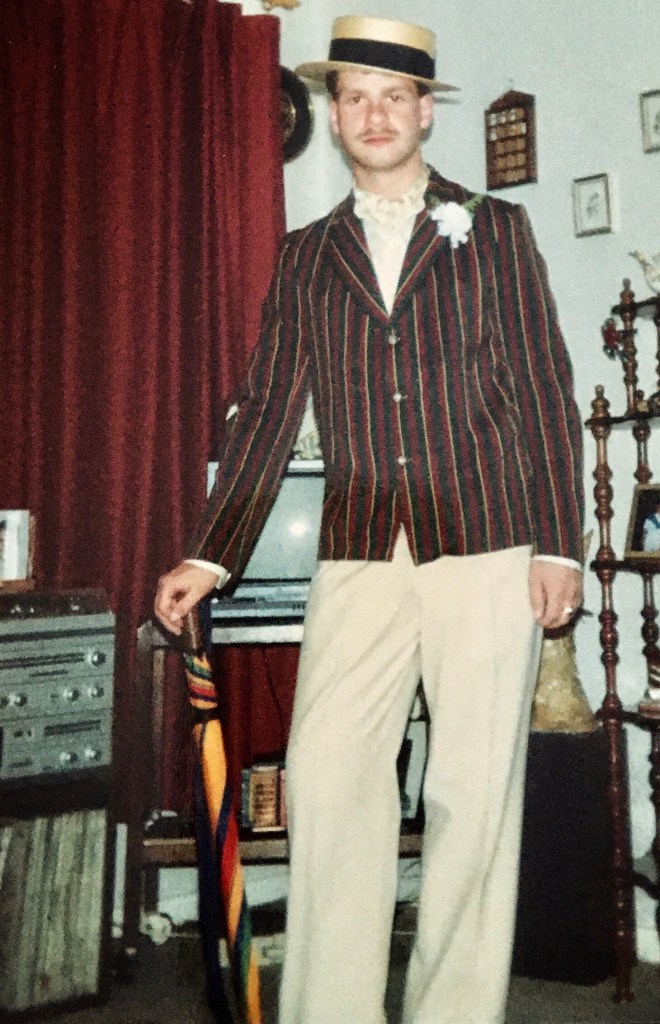
I used every opportunity to try on ladies and men’s shoes that took my fancy. I fell into the role of clown, parading around the stock rooms, much to the delight of my coworkers.
We purchased our own uniforms. Males wore a suit with shirt and tie. My female counterparts an outfit selected by the floor supervisor, a tall slim, Miss Dixon. It changed twice per year and did not suit all body shapes.
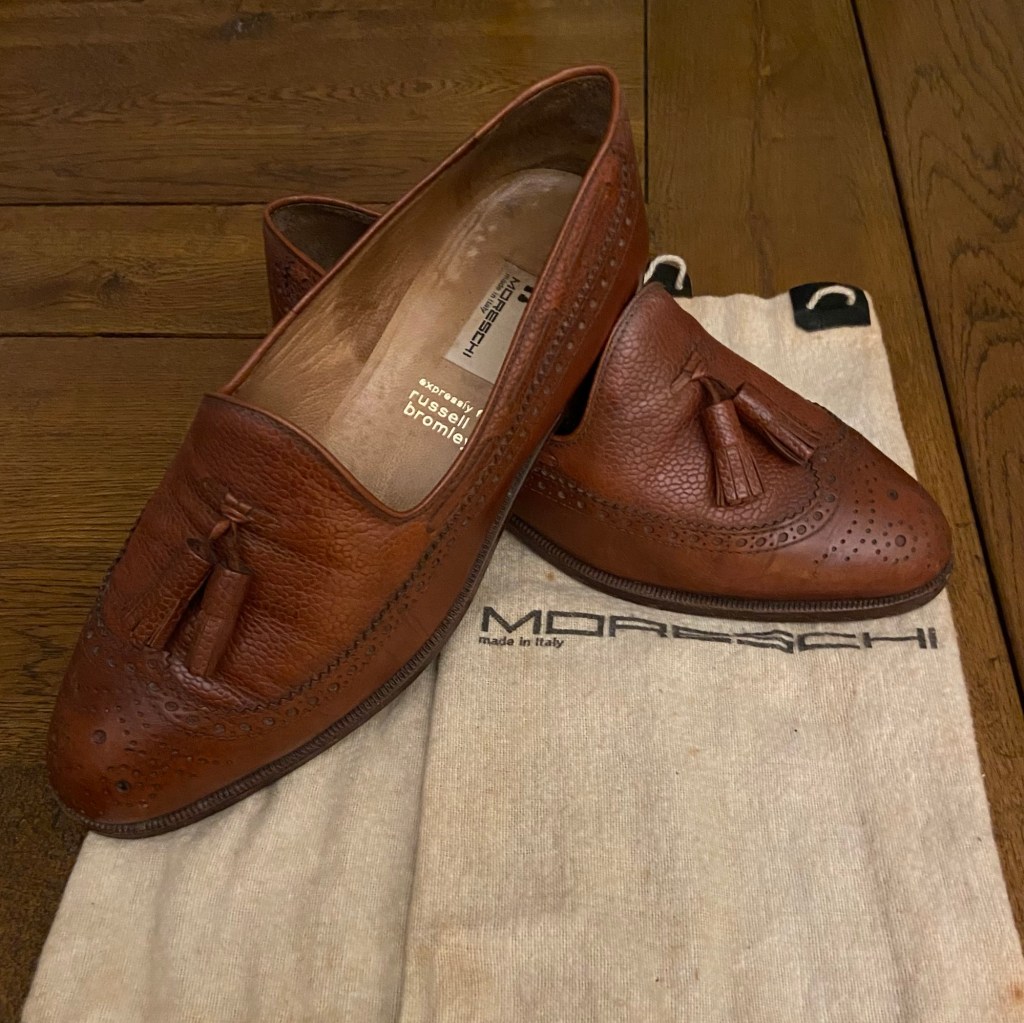
A condition of our service was the wearing of a pair of ‘shop shoes’ from the company’s range for six months. They were not allowed to leave the premises. Our bags were checked every time we went out. We paid a quarter of the retail price. I chose a £100 pair of tan Moreschi tasselled half brogue loafers with a grosgrain vamp.
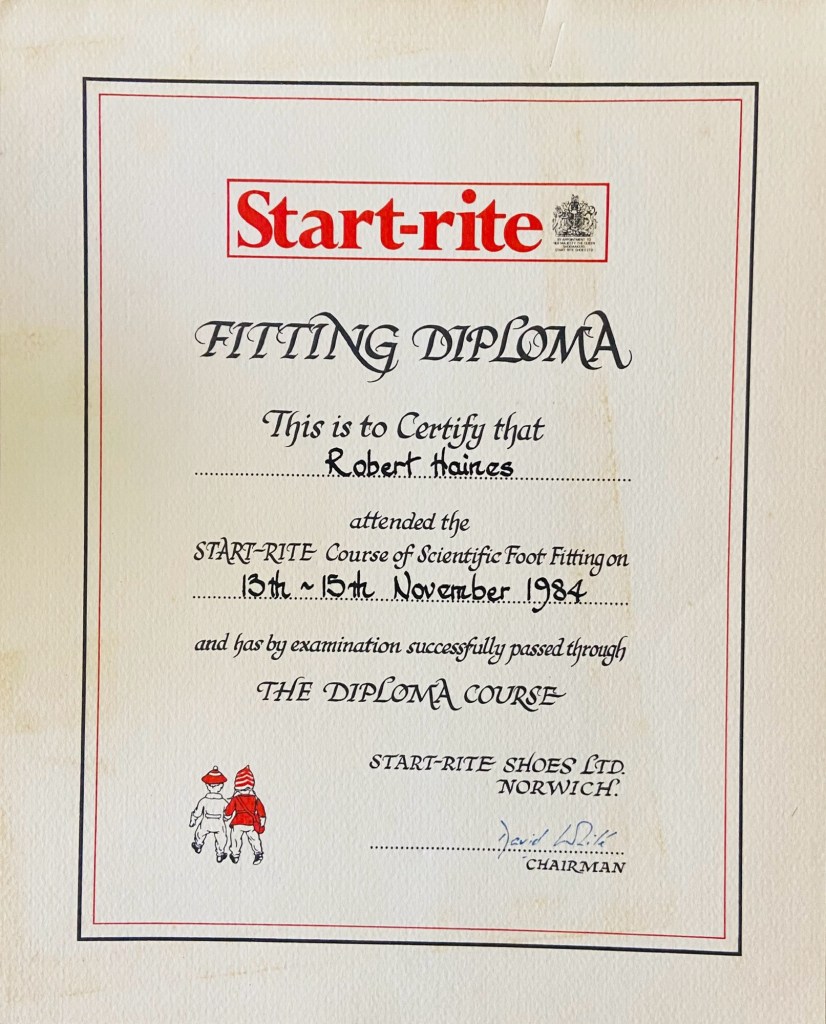
During my time there, I attended a course on fitting children’s shoes in Norwich at the Startrite factory so that I could assist during busy back to school periods.
My work mate, Tracey ‘ace face’ Melling ran the children’s department on the mezzanine. Outside work, a goth with backcombed hair, ripped black clothing, and black, white, and purple makeup. Each day, Tracey drew on eyebrows after arriving late to work. I still smile at the thought of the surprised faces of children and parents looking at Tracey without eyebrows or with only one drawn on.
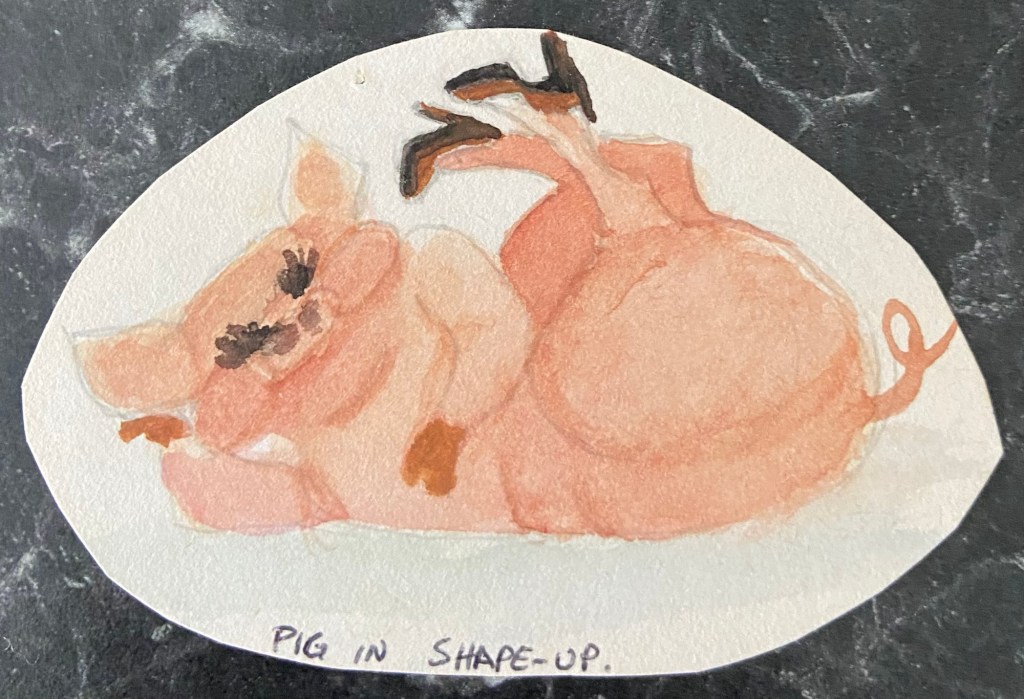
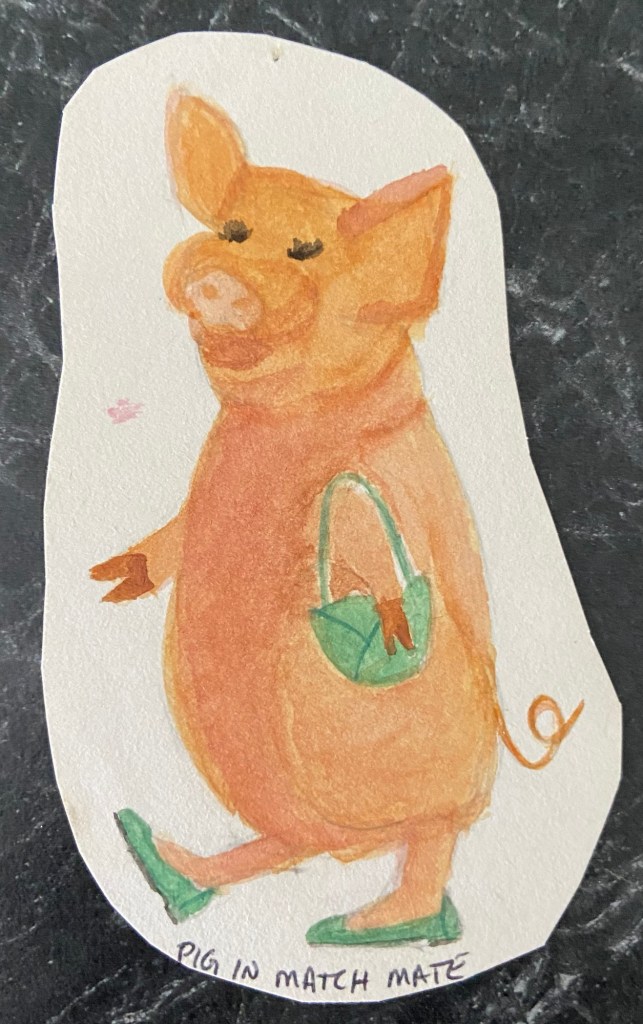
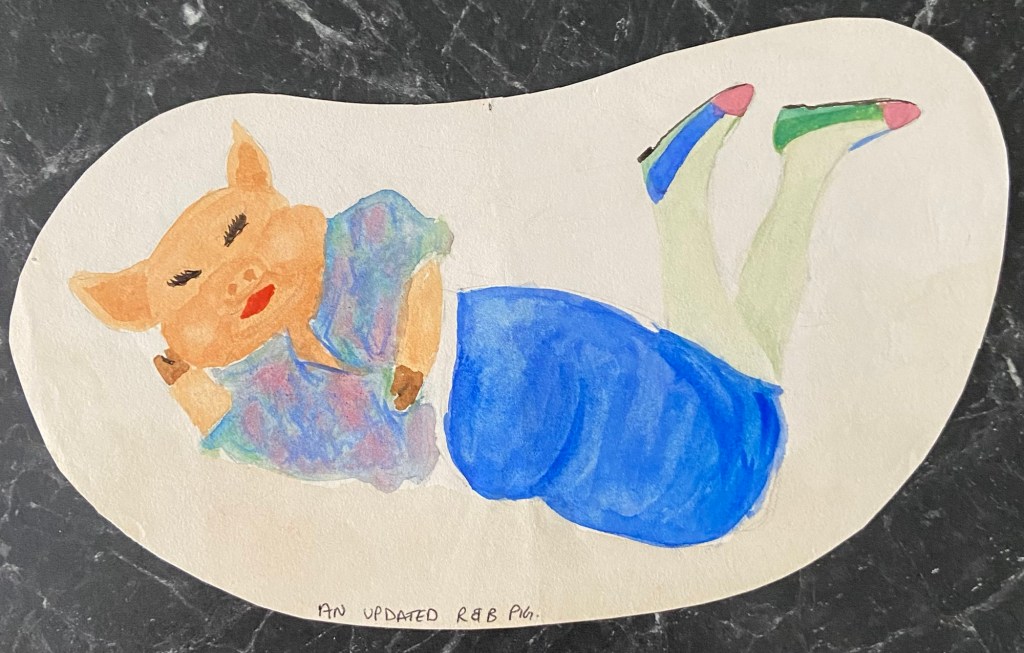
Tracey was hugely creative. During a quiet period, Tracey drew pencil sketches of pigs wearing R&B shoes on the back of Clarks packing labels. I was gifted with the sketches which I copied to paint corresponding watercolours.
I began at R&B during the period of the Autumn/Winter uniform of black skirt and dark raspberry blouse.
Spring/Summer followed, Capri skirt with blouse of splodges of blue, pink, and green.
Fully utilising a 25% discount, my shoe collection grew to include leather soled and lined canvas shoes in two tone blue and in fawn; polished burgundy, black, dark brown, and dark fawn suede brogues, tan boxer boots, the list goes on. Only the Moreschis remain.
Late ‘80s; underground ‘private’ clubs, grubby pubs; Inversion is hidden away in plainest sight, Now legal, nonetheless, socially perilous, Femininity’s locked away without a key.
Second quadrennial ‘affair’*; entitled chap, Of Lytham Saint Anne’s, Lancashire stock, don’t you know? Exploiting connections, airs and graces galore, Drawn to fine foods, wines, kudos, fast cars, excitement. I’m rendered servile in the presence of elite.
Joint tenants, red brick, Victorian, end terrace, I name it, ‘Willow House’, though no willow in sight. Small metal gate opens onto a brief brick path, Slate stone threshold, kitsch half moon pane, crimson front door, Above, oblong fanlight with cathedral glimpses!
Light touch renovation; clean, clear seal ground floor boards, Dip internal doors to strip away life’s layers, Swap sixties tiled slabs for period fireplaces, Hey presto! Urban townhouse to rural cottage.
First floor back bedroom, mine if his parents ask us. Door’s ajar. Visitors staying, florist and beau, Discover him reclining naked on the bed, Brawny quintessential physique, bubble bum, Fine downy coating, glinting in afternoon sun. Quietly, slip away, sure he doesn’t see me. Later on, I’m the butt of jokes over shared drinks.
Weekend, apricot moire, papered parlour scene: Stiff deco walnut armchairs; one pound auction find, Afront, gold veined black painted faux marbled fireplace, Aside, light stone topped, tiled washstand, reused for booze, Over, gilt framed, Venetian Canaletto prints, Chaise in bay window, birds of paradise flowers, Aback, heavy floral chintz curtains, swags and tails, News sheets strewn across Pratley’s ivory Chinese rug Abutting, an artichoke Lusty Lloyd Loom leg; Cafetière doesn’t steam away morning’s chill.
Sand dining room; dust motes shimmering in sunshine, Shafting below partly closed weighty Roman blind, Dressed with vintage burgundy velvet drapery. Beyond, rear narrow walled plot, poppies are in bloom. Satisfying nostril tickling, scents of freshly Waxed antique pine furniture, and lavender waft From bunches hanging upside down in the kitchen. Happily home alone, sipping cup of Earl Grey, Reflecting on ‘Shout, shout, let it all out, these are the things I can do without’.
Away from the formal, descend short flight, turn right, Heart quickens, take care, ignore the rarely used door, Behind lies coal cellar, where light’s absorbed by dank, Dark, under foreroom and hall, too scary to face. Forth, equidistant verdant serpentine vines climb, Sprouting lemon and azure blooms in low ceilinged, Subterranean sanctuary, inherent gloom.
Pause.
Fluorescent tubes flood, mortuary white, revealing Mid twenties magpie snob, squandering time and cash, Amass finery tuppenny-ha’penny means. Ranging death in a basket, hot glue blisters, burns, Potpourri of skills, emotional scars to learn. Monday to Friday, big smoke commute, fall in line To fund unnecessarily larger new house.
*I find it bizarrely intriguing, the word affair was used to describe one’s boyfriend e.g. ‘there he goes with his affair’.
On Tuesday 27 June 2023, my mother would have been eighty eight years old. She used to joke about being the embodiment of war and peace; Eirene was the Greek goddess of peace whilst Edith comes from the Old English Eadgyð, encompassing the elements ead, meaning “riches” or “blessed,” and gyð, meaning “war.”
To me, my mother was a fearsome presence who took up the mantle of raising three sons and contributing to the lives of her grandchildren and the British Polio Fellowship with selfless determination and pride.
As a no nonsense let’s sort this out persons, Mom resolved the question of my secondary school by going to the headquarters of the Birmingham Education Department and not leaving until she had confirmation, I was not going to the local one with a reputation of high levels of bullying.
From an early age, Mom encouraged us to pursue our interests. There was no judgement from her when as a child, I created a teddy bear bridal parade using a pale blue nylon and polyester night dress she had donated for me to use. When at a loss at what I wanted to ‘do’ at a meeting with the career advisor at secondary school, Mom said gently, ‘you like making cakes, Rob’; the decision was made, catering college was the next step.
My husband and the grandchildren brought out a softer affectionate side to Mom’s resolute force.
She insisted on keeping an immaculately clean home. During school holidays our chores included washing the skirting boards and architraves throughout the house.
Mom graciously welcomed guests sharing what she had even though her meagre weekly budget had to be tightly managed.
Through sheer determination, Mom contradicted the prognosis of doctors who said she would never sit up unaided, let alone walk after contracting polio at eighteen months old. Mom refused to visit Stratford-on-Avon as it was believed the river Avon was the source of her infection.
Not giving into the restrictions of her body was part of Mom’s being. Mom wore a full caliper (leg brace) on the left leg to take the weight of the left side of her body.
One of Mom’s stories recounted a day during the Second World War when she jumped into a hole, breaking the caliper. Back then the NHS (National Health Service) did not fund the caliper. Mom’s parents were understandably not amused.
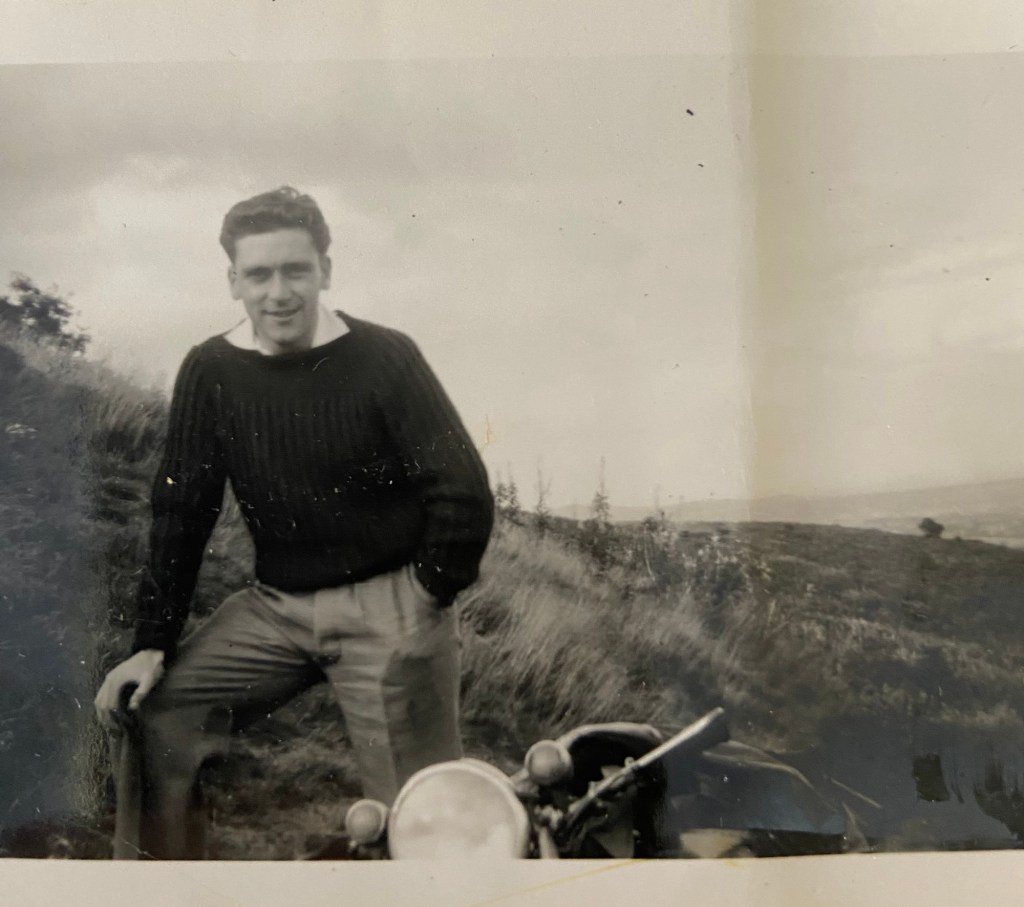
The adult caliper consisted of a deep padded leather thigh brace similar in shape to a bucket fastened with heavy duty leather straps, along with leather knee and ankle braces fastened with leather straps. Each brace was connected to the next with bilateral steel struts. The knee had a mechanism to lock the leg straight or release it to be able to sit down. The caliper had a raised steel platform at the bottom to correct the three and half inches difference in length between Mom’s legs. There was a steel peg underneath the platform covered with a rubber ferrule. The whole thing weighed around 14lbs. This did not stop Mom from touring Snowdonia, Wales in the ‘50s riding pillion on my Dad’s motorbike.
Mom’s morning routine included tightly wrapping the left leg from thigh to ankle in crepe bandage to help prevent chafing and keep it warm due to pour blood circulation. A crepe sock and tights finished the ensemble.
Mom’s peers at school were as cruel with taunts as you can imagine however, calling her peg leg, hop along or a cripple would result in a clout. The bravado covered up a sense of self-consciousness. Up to her sixties, Mom chose to wear slacks to hide the caliper from judging eyes.
In middle age, Mom steadfastly refused to use a wheelchair preferring to switch to a considerably lighter cosmetic leg brace having full length moulded plastic upper and lower limb cradles, fastened with Velcro straps plus an updated locking hinge at the knee. A custom made built up shoe plus a sturdy right shoe completed the ensemble. The NHS funded one pair of shoes every two years. Mom could choose from a colour range of black, brown, navy, mid-grey, claret, or fawn. There was only one fully enclosed lace up style available. A below knee brace had to be added to the right leg to provide support as it had degenerated doing the job of two legs.
Mom spent decades battling the symptoms of post polio syndrome and in managing the excruciating pain and physical restrictions of spinal osteoarthritis. She was an early adopter of acupuncture sessions to help relieve the pain.
Eventually, Mom found a new lease of life using a motorised wheelchair. In my mind, I can still see her whizzing around the house singing along and dancing to her favourite vinyl albums of James Last and his Orchestra. She thought his music lifted her spirits allowing to fly.
My second step-dad, Barry quietly and gently adored and cared for Mom. He arranged for Mom to meet her idol, Mr Last back stage after one of his concerts. Mom proudly displayed a framed photograph of the two of them meeting on the living room wall.
A fortune telling gypsy told Mom she would live until ninety, I truly believed this would be the case.
The last time I saw Mom in person was when she turned seventy. After demanding of herself a full life, complications from a respiratory infection took Mom fours years later in 2009.
It has taken me this long to come to terms with her passing. It’s perhaps not a good look typing during the work commute with tears running down my face while listening to James Last on Spotify; it’s okay no one is paying attention.
On the third morning of writing this epic composition, I am calmly listening to Non Stop Dancing 8 from Mr Last in 1969 to herald the memory of a great and wonder-filled woman, Irene Edith, Mom.
There are times when I lose myself down an Internet browser rabbit hole. One of the most recent was when attempting to satisfy my curiosity about how the word ‘bob’ became slang for a shilling.
The above example was minted in the year of my birth. Back then there were 12 pennies in a shilling and 20 shillings to the pound, but within that were farthings (quarter of a penny), halfpennies, thrupenny bits, tanners (six pennies), half-crowns, crowns and florins (two shillings).
This system was in use for over a millennium and had its origins in Roman times, when a pound of silver would be divided into 240 denarii.
On 15 February 1971, currency in the UK was decimalised. New coinage was issued alongside the old coins. 5p and 10p were the first to appear, introduced in April 1968. They were the same size, composition and value as the old shilling and florin coins, and circulated interchangeably with them. In October 1969 a 50p coin was introduced, and as D-Day approached, the old halfpenny, half-crown, and 10 shilling notes were withdrawn from circulation.
I found the following bob meanings:
hairstyle
slang for a shilling, unit of pre-decimalised English (and other nations’) currency
Abbreviation of plumb-bob
Victorian era abbreviation of bob-stick, measure of gin
I romantically assume, the purpose of schooling in 1960’s and 1970’s UK was to provide a general introduction to topics. A catalyst to inspire fresh minds to develop skills and assist in identifying one’s career path.
Primary school was all about singing, maypole dancing, being statues, playing percussion instruments, needlework, beanbags, art, decimalisation, decorating walls with forest gauging paper collages, playing ‘what’s the time Mr Wolf?’, free milk, and carbolic soap.
Streaming in secondary school labelled the ‘brightest’ two groups as ‘A’s destined for G.C.E ‘O’ and ‘A’ level study* whilst the three groups of ‘B’s were setup for C.S.E.s**. The remaining ‘R’ group of remedial students were segregated from the rest. It was rumoured they were consigned to a single room, secreted away somewhere to avoid sullying the reputation of the school and tainting the achievers.
In the first halcyon year, I realised my passions in art, pottery, drama, music, the Dewey decimal system organised library, history, English, French, and German. Dislikes included, P.E. (physical education), R.E. (religious education), geography, and science. Also, boys only, woodwork, metalwork, and technical drawing.
Girls only, typing, sewing, and domestic science were more preferable to me, sadly out of reach.
When electing a program of certificated study from the second year onwards, English language, mathematics, sports (cringe) and one science subject were compulsory. I elected courses in history, French, German, music (violin then oboe), pottery, and English literature.
As biology turned my stomach, chemistry was smelly and required an in-depth knowledge of the periodic table, physics was the only option left.
Even though as a youth and now, I had a terribly disorganised and random mind, I found solace in algebra and measuring objects.
For decades, I held onto the dog eared, pale peach gloss coloured logarithmic and other tables booklet. The cover retained an archive of finger prints, biro marks, food stains and liquid spill marks.
Unfortunately, my final year of secondary studies and fifth year examinations took place 30 kms south in a high school local to our new council house assigned to our family as part of the ‘Birmingham overspill’.
Somehow, I scraped by with four ‘O’ levels in English language, mathematics, history, and ceramics plus C.S.Es physics, German, and music (oral). Sufficient enough to commence an ordinary national diploma in hospitality.
In hindsight, we would have benefitted from courses in cooking, cleaning, laundry, personal hygiene, budgeting, safety, tolerance, respect, and communication skills.
I didn’t give up on French, gaining a high distinction in language and culture at university level in Australia.
*General Certificate of Education at Ordinary and Advanced level provided access to tertiary level technical and polytechnic colleges, and universities.
**Certificate of Secondary Education gained access to tertiary level technical colleges, trade schools, and apprenticeships.
As a teenager in the UK, I had a few part time jobs. The first was serving takeaway fish and chips in a timber framed shop with higgledy-piggledy floors, ceilings, windows and doors. It was located in a high street where the buildings appeared to have collided into each other.
The income paid for uniforms, chef’s knives, and books, required for study. Following the start of a two-year sandwich course*, I was informed I needed to get experience working in a more superior hospitality business. I was fortunate in securing the role of banqueting waiter at a half timbered C16th hotel.
The business was purchased by a local hotel group, leading to my first redundancy and redeployment. The new hall porter position was located at a grand C19th mansion, turned hotel and function centre. The group also ran the lido in the town. Each Summer staff had the opportunity of working in the lido kiosk.
As my heritage is more Northern European than Mediterranean, my pasty white limbs would sear to a deep vermilion when flaunted in the sun. In order to protect my fragile ego I opted to succumb to packaged promises of golden to bronzed litheness.
Quelle horreur and indignity I endured exposing the resulting patchy brown reality!
*a training course with alternate periods of formal instruction and practical experience.
FAT man photos recently posted images of Weston-super-Mare. They reminded me of the last time I was there, fourteen years ago.
A day trip from Worcester, with my husband, late Mother and Step-Father no.2 (SF2). In my memory it remains a sunny and happy day, filled with colour.
This is even taking into consideration, the annoyingly loud deh-deh-di-deh and blarb noises from SF2’s traffic light and speed camera warning device; allllll the way there and alllll the way back. Oh, and the electric wheelchair running out of juice, and a proliferation of disabled-toilets that were moonlighting as furniture storerooms and changing rooms. Much to the chagrin of my Mother.
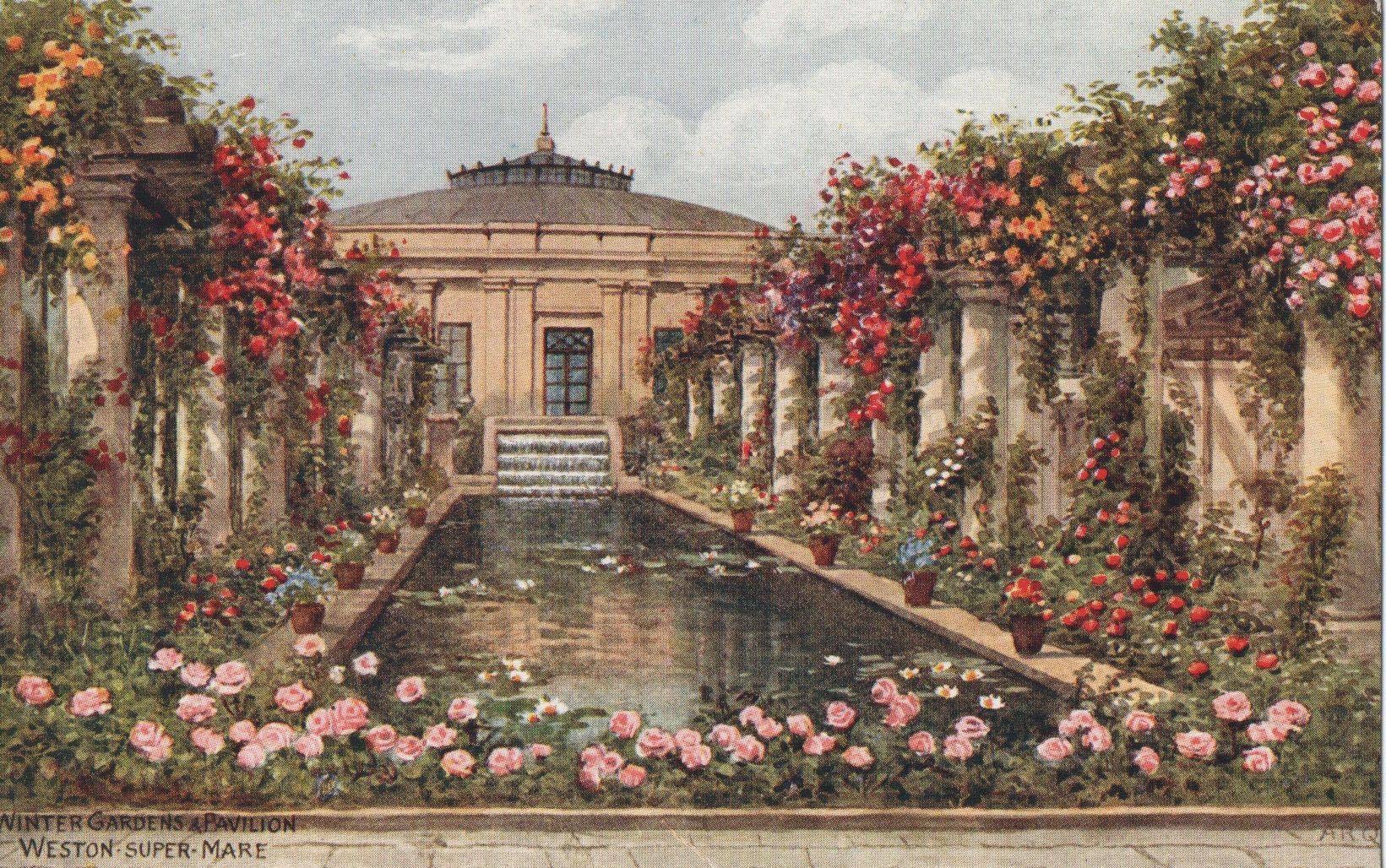
I have been to Weston two or three times. The first when around nine or ten years old, in the 1970s. Foggy memories of a postcard from the time. Winter Gardens backdrop to a long pool, flanked by flower draped arcades.
I imagine we would have made this journey by train or coach from Birmingham. One of the first holidays with Mother, Brothers, and Step-Father no.1 (SF1). I vaguely remember staying in a bed and breakfast and visiting a family who lived on a caravan park. I distinctly remember sketching an older boy reclining on a bed.
The beach, made up of sand then mud seems to go out for miles, towards the elusive sea. Within the family the beachside town was known fondly as Weston-super-Mud.
The second time was on the way to somewhere else, in the 1980s with Richard, my late best friend. Of that day, memories of cold wind and rain remain.
The great green glory of nature is encapsulated in the hypnotic rustle and sway of the grasses, surrounding Coate Water.
Nine years have passed since I last trod upon this pleasant land. Sadness and loss formed the backdrop of that visit. It took the wedding of a special family member and much coercing to get me to make the journey.
Time with family in celebration and basking in the warmth of friendship have made many happy memories.
In drinking deeply of the verdant oases of Swindon, Portishead and the surrounding countryside of Wiltshire and Somerset, I have renewed my love of England, country of my birth.
Invigorated and refreshed; we soon commence our return to Australia, via Italy.









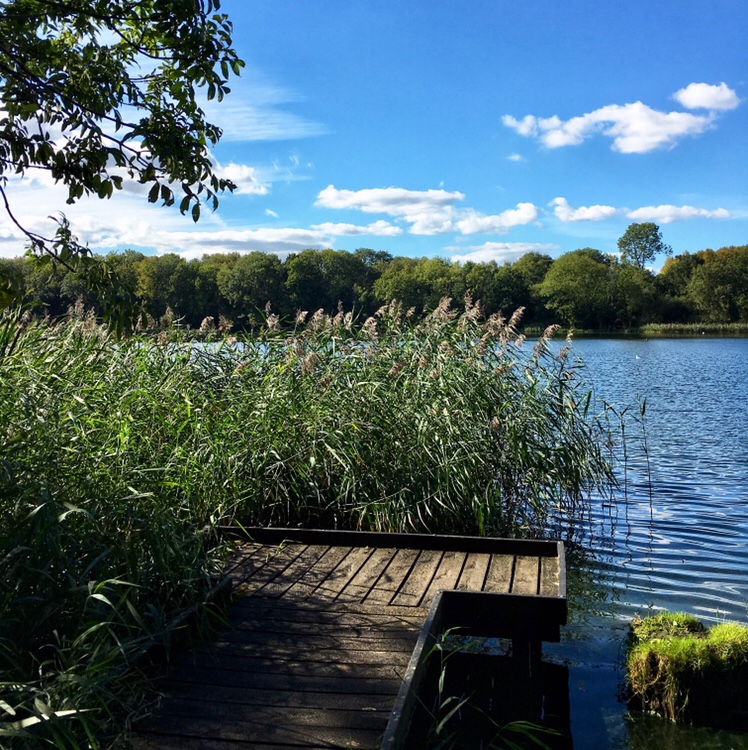 The great green glory of nature is encapsulated in the hypnotic rustle and sway of the grasses, surrounding Coate Water.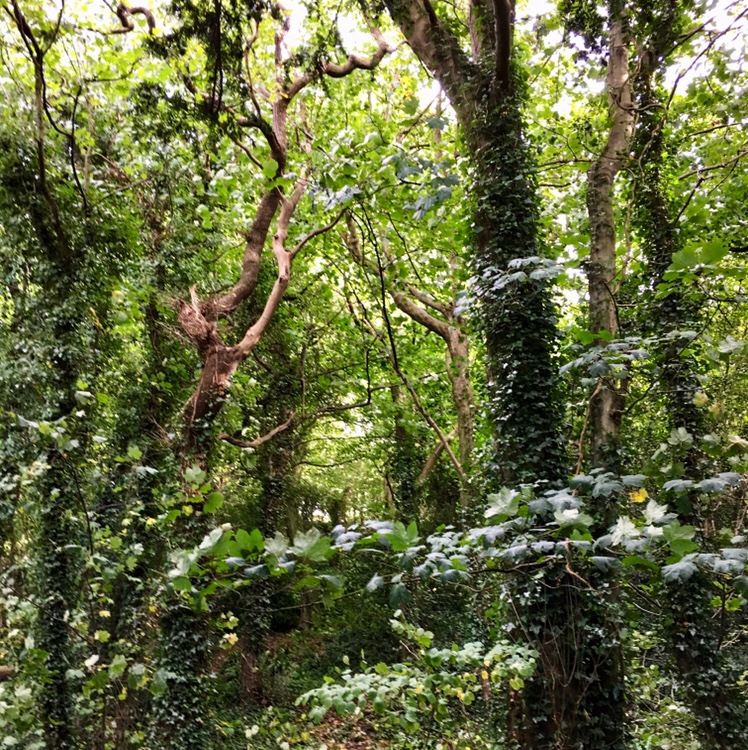
 theINFP